TransEpiscopal
  • Home
  • About
  • Blog
  • Resources
    • Transgender 101
    • Pastoral Care
    • Welcome and Inclusion >
      • Nonbinary Resources
      • Assessment Tool for Churches
    • Liturgy Resources
    • Scripture and Theology
    • Children and Youth
    • Spanish Language
    • LGBTQ 101
    • Further Reading & Resources
  • Policies & Legislation
  • Contact
  • Donate

The Listening Process Compared

7/6/2012

0 Comments

 
By the Rev. Dr. Christina Beardsley of Changing Attitude

This afternoon I attended the hearing of the Ministry Committee considering Resolution D002 which would add the category ‘gender identity and expression’ to the non-discrimination canon for the ordination discernment process, and D019 which would add the same wording to the Episcopal Church’s canon on access of the laity to all levels of church participation and representation. These additions, as one speaker remarked, were a necessary enhancement to the standard of welcome - at policy level at least - in the Episcopal Church.

Forty-five minutes was set aside for testimonies, with each person assigned two minutes for their contribution. No one had signed up to oppose D019 and only one person spoke against D002. Indeed, so many people had signed up to testify in favour of D002 that the forty-five minutes was reached before everyone had a chance to speak. I had signed up to testify about the Church of England context, which is not that different from that of the US, and I’ll append the testimony I had prepared below (in italics).

The testimonies over, I stayed on in the committee room to hear the discussion by the deputies and bishops and to await their outcome. The process is entirely open, not behind closed doors. I’m merely a visitor to the Convention, from another Province altogether, but I could have testified had there been time, and was, with others, privy to how the decision was made. It was very easy really. The deputies and bishops were appreciative of the courage of all who spoke – including the individual who spoke to the minority position - and there was a commitment on both sides to mutual listening. When it came to the vote there was hardly any discussion – the rightness and justice of full inclusion for trans people was almost unanimous. Now the Resolutions must go to the House of Bishops and the House of Deputies where there is likely to be much more debate, but this is a wonderful start.

What a contrast between my experience today and what happened to Colin, Keith, Jenny and Rob in their meeting with the Pilling Committee at Church House. I wasn’t there so I don’t know the tone in which the chair’s comments were made, but this is a working party that is supposed to be reviewing the listening process in the Church of England. Ought it not to be modelling listening to LGB&T people rather than lecturing them about how things are done in the Civil Service? Or was this intended as avuncular advice to an organisation that was once considered safe by the church establishment, but that now, in the face of an intractable culture, has become increasingly edgy, radical, and ready to say exactly what we think rather than what people would prefer to hear? Whatever the motives it sounds quite bruising for those who were there.

Changing Attitude, England, like the other organisations which have been called so far by the working party, has had its allotted hour. What happens next? I’m sure we won’t be privy to the discussions of the working party as I was to those of the Ministry Committee at General Convention today. As a delegate to the Triennial Women’s the Triennial Women’s Convention – which runs parallel to General Convention – observed to me this afternoon, the protocols of General Convention are modelled on those of the United States Senate and Congress. The model for the central bodies of the Church of England, as Sir Joseph reminded Colin today, is the British Civil Service. Excellent as that may be for purposes of government, in the context of the listening process it doesn’t seem to be creating a safe space for lesbian, gay, bisexual and trans people to be heard. So, London or Indiana? I know where I would rather have given my testimony today, and here it is:   

My name is Christina Beardsley.  I’m a visitor from the Diocese of London, England. I’ve been a priest for thirty-three years. I transitioned eleven years ago so I’ve spent a third of my ministry as a trans woman working throughout that time as a hospital chaplain. I’m now the Head of a Multi-faith Chaplaincy team and manage more than twenty people. 
  
I’m aware of seven trans clergy in the Church of England who have transitioned – exactly the same number as in the United States. Two are parish priests, one has an active ministry in retirement, three are in secular employment but involved in their parish and diocese, and I am in a sector ministry.
An English House of Bishops working group’s reflections on trans people in the life of the Church, including ordination, were published in 2003 as Chapter 7 of ‘Some issues in human sexuality 

In 2002 the English House of Bishops discussed the discernment process for trans candidates and the outcome can be found in the Handbook for Diocesan Directors of Ordinands, Section 2.16, which sets this out in detail.

You might expect me, as an English person, to say that it was ‘time for t’ but by that I don’t mean time for a cup of tea: I mean it is now time for the letter T -  for Trans -  and I urge you to add ‘gender identity and expression’ to your non-discrimination canons.
0 Comments

Hearing on D002 and D019: Powerful Witness

7/5/2012

0 Comments


This afternoon the Ministry Committee heard resolutions D002 and D019.  The room was full, the testimony sign-up lists overflowing with overwhelmingly supportive people.  The committee itself is large—forty members – which made getting up to speak that much more overwhelming for those who did it.  But what an amazing collective witness we offered.  

In addition to trans people ourselves, a striking number of allies came forward, including two bishops.  One of them was my bishop, Tom Shaw, who spoke of our experience in the diocese of Massachusetts with trans clergy as well as strong support for the trans community more generally.  Striking testimony was offered by Vivian Taylor whose writings have been share on this blog before.  Vivian spoke of finding a home in the Episcopal Church during college, prior to her deployment to Iraq as a chaplain’s assistant, and her intention to enter discernment for ordained ministry.  Bishop Chet Talton spoke of the stance of full welcome that he has supported in the Diocese of San Joaquin, and of the ministry of Carolyn Woodall who was ordained a deacon this spring.  

The lone dissenting testimony was offered by a deputy from the diocese of Albany.  The main sentiment she shared was a sense of isolation in her disagreement with resolution D002.  When gently pressed by Bishop Mary Glasspool to be more specific about her concern, the deputy indicated her belief that “God doesn’t make mistakes” and that those who transition inherently assert the opposite. Bishop Shaw and I also answered a question from another deputy from the diocese of Albany about how to respond to people in that diocese who may feel alienated by the passage of these resolutions.  Both of us emphasized the importance of relationships, of staying in conversation, of recognizing the humanity of one another, even and especially when we disagree.  This deputy also turned out to live only twenty minutes from where my spouse grew up in central New York state.  The world is small, and we must be gentle to one another. 

After forty-five minutes of testimony on both resolutions, the chair ended the session.  Because there were so many more people who wanted to testify, unfortunately, many were not able to, and we will be posting more testimony here.  When the session ended, we streamed out into the hall, hugging each other and sighing huge sighs of relief.  While a number of us dispersed, a few stayed behind to hear debate and voting on the resolutions.  As it turned out, the vote was very straight forward:  both D002 and D019 were passed out of committee and now head to the House of Bishops.  They should come there in the next couple of days.  

Tomorrow at 2pm there will be a hearing on another trans related resolution, D022, the Churchwide Response to Bullying.  Stay  tuned for news on that resolution as well as House of Bishops movement on D002 and D019.

- The Rev'd Dr. Cameron Partridge
0 Comments

Off and Running

7/4/2012

0 Comments

 
PictureShortly after arriving, TransEpiscopal members and friends gathered in the booth area.
General Convention 2012: Off and Running
The TransEpiscopal team has hit the ground running here at The Episcopal Church’s 77th General Convention in steamy Indianapolis.  Most of us arrived on Monday, and yesterday was a day of joy and discovery, as many people who knew each other only online finally got to meet in person.  For the first time we have our own booth in the Convention exhibit hall, and over the last two days we have been meeting people from across the church in that space.  As in 2009, I am so struck by the sense of interconnection, and especially the unexpected ways that people from all across the church are connected specifically to trans people.

Yesterday I met a priest from a Midwestern diocese who had watched the documentary Out of the Box last Saturday evening.  She was moved to make a connection in her sermon between the gospel passage last Sunday and the idea of being and acting “out of the box.”  She talked about how our church would be looking at resolutions adding “gender identity and expression” to the church’s nondiscrimination canons here at General Convention.  Two parishioners then thanked her for her words and shared that each of them were parents of transgender people.  This was the second instance of a priest I know preaching about transgender equality this past Sunday.

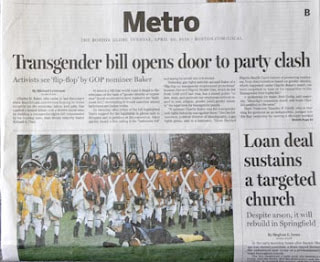
The other one was a friend in Massachusetts where our state nondiscrimination law just went into effect on Sunday.  I was moved to see coverage of this law in a headline at the top of the Boston Globe metro section as I flew to Indianapolis Monday morning.  The sense of celebration and of momentum coming into General Convention has been powerful.

There are three resolutions that TransEpiscopal is supporting along with our coalition partners in IntegrityUSA, the Consultation, and the Chicago Consultation:

D002 “Affirming Access to the Discernment Process for Ministry”

This resolution would add “gender identity and expression” to Canon 3.1.2, the church’s nondiscrimination canon for access to the ordination process.  This addition would make explicit that ordained ministry is open to transgender people. 

D019 “Amend Canon I.17.5 - Extending the Rights of Laity”

This resolution would add “gender identity and expression” to Canon 1.17.5, the church’s nondiscrimination canon for access of lay people to all levels of the life of the church.

D022 “Church wide Response to Bullying”

This resolution calls for a church wide response to the epidemic of bullying, including those targeted because of their gender identity or gender expression.

D002 and D019 were assigned to the Ministry Committee, and hearings on them will take place tomorrow at 2pm.  TransEpiscopal members and allies are preparing now to testify.  Once the hearings take place, the committee has to decide whether to send them along to one of the two Houses in The Episcopal Church’s bicameral system.  So stay tuned for more on that front, as well as the fate of D022, the resolution on bullying.

Meanwhile, today has been packed with hearings on various other numerous resolutions, including marriage equality, the impact of DOMA on couples with an immigrant member, and many, many more.  
  
This afternoon, I was joined by Rev. Dr. Christina Beardsley (of Changing Attutude) at the Consultation’s Speaker’s Corner in the exhibit hall. We gave an overview of the trans-related resolutions before us, and the broader context for movement on trans equality in the Episcopal Church and Anglican Communion.  We emphasized that the last General Convention passed four transgender supportive resolutions, falling short only on C061, now called D002.  Tina also spoke about the longstanding presence of transgender clergy in the Church of England, as well as the collaborative work that has been taking place between various "LGB and T"(as she puts it) and allied groups.

Between the end of the Speaker’s Corner and Integrity’s double feature of Out of the Box and Love Free Or Die, we learned that resolutions D002 and D019 were going to receive a joint hearing tomorrow at 2pm in the Ministry Committee.  

With that knowledge, we came into the room packed for the double feature.  Out of the Box had begun when I scooted into a free row to grab a seat.  After sitting down I looked up and realized I was directly behind my bishop Tom Shaw who plays a prominent part in Love Free or Die.  He turned around and grinned at my comment in Out of the Box about my decision to transition feeling like Christmas morning.  I laughed out loud at the scene of him in the water fight.  Seeing each of us up on the big screen was a little surreal.  As Bishop Gene Robinson went on to say in the panel afterward, as difficult a time it is in the life of the church, it is also such an amazing, wondrous time.  What a privilege to be part of this holy work of transformation.

So now at the end of this second full day in Indianapolis, we prepare for our hearing tomorrow.  Please keep us all in your prayers, that minds would be clear and hearts be open.

- The Rev'd Dr. Cameron Partridge

Picture
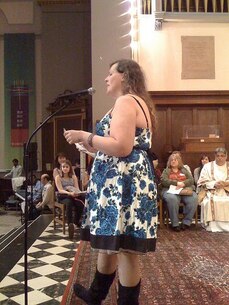
The Reverend Dr. Tina Beardsley of Changing Attitude UK speaking at the Consultation Speaker's Corner
Picture
Panel for the film Voices of Witness: Out of the Box. From right to left: Bishop Gene Robinson, the Reverend Deacon Carolyn Woodall, the Reverend Dante Tavolaro, the Reverend Carla Robinson, the Reverend Cameron Partridge
0 Comments

Countdown to General Convention: Resolutions D002 & D019

6/29/2012

0 Comments

 
Picture
Resolutions D002 and D019 seek to add "gender identity and expression" to the list of categories protected from discrimination in the church, including access to the discernment process for ordination (D012) and also more generally to the life, worship and governance of the church (D019).

Gender identity is one's inner sense of being male, female, or something more complex; gender expression is the way in which one manifests that gender identity in the world. These resolutions are based on our growing understanding and practice in church to respect the dignity of transgender persons (transsexuals, and others who differ from majority societal gender norms).

In 2009, a group of eight transgender Episcopalians--four lay people, a deacon, and four priests, ranging in age from 19 to 70 and hailing from dioceses around the church--went to General Convention to urge passage of several resolutions. They were organized by TransEpiscopal, which coordinated its work with Integrity's legislative team. Also in 2009, Deputy Dante Tavalaro of the Diocese of Rhode Island was the first openly transgender member of the House of Deputies. It was a groundbreaking year.

Although 2009 was the first time that any resolution on transgender concerns ever made it out of committee and onto the floor of either House, several trans-friendly resolutions were passed by wide margins, including a resolution calling for national, state and local laws to protect transgender persons from employment discrimination and violence. However, the resolution on access to the ordination process ultimately failed.

It did pass the House of Deputies by a super-majority, but after much debate was amended in the House of Bishops to drop reference to all specific protected categories such as race, gender, national origin, etc., in favor of the word "all." Because "all" does not always yet mean all in the Episcopal Church, and because naming those protections has been a long struggle over years, TransEpiscopal, Integrity, and other groups recommended that the House of Deputies vote no on the amended resolution, effectively killing the resolution.

This year D002 brings back that same resolution, along with D019 to address access to the church's wider life.TransEpiscopal is sending another team of advocates, and Integrity has made passage of these resolutions a top priority for this convention. For a more in-depth look at the life and ministries of several transgender Episcopalians, check out the Integrity-produced video, Voices of Witness: Out of the Box on YouTube, or -- if you're going to be in Indianapolis -- attend the screening at the Convention Center on July 4th. 

- Deputy Sarah Lawton, Diocese of California
Reposted from the Walking with Integrity Blog

D002 Affirming Access to the Ordination Process


Resolved, the House of _______ concurring, That Title III, Canon 1, Sec. 2 of  the Canons of the Episcopal Church be hereby amended to read as follows: No person shall be denied access to the discernment process for any ministry, lay or ordained, in this Church because of race, color, ethnic origin, national origin, sex, marital status, sexual orientation, gender identity and expression, disabilities or age, except as otherwise provided by these Canons. No right to licensing, ordination, or election is hereby established.

EXPLANATION

Title III, Canon 1, Sec. 2 of the Canons of the Episcopal Church states "No person shall be denied access to the discernment process for any ministry, lay or ordained, in this Church because of race, color, ethnic origin, national origin, sex, marital status, sexual orientation, disabilities or age, except as otherwise provided by these Canons. No right to licensing, ordination, or election is hereby established." This resolution would revise this canon by adding "gender identity and expression" to this list of protected categories of access, but not of right.

As we continue to grow in our understanding and embrace of all human beings, it is important for us to be
specific in our naming of difference. This proposed revision is based upon our increased understanding and practice to respect the human dignity of transgender people - transsexuals, and others who differ from majority societal gender norms. Gender identity (one's inner sense of being male or female) and expression (the way in which one manifests that gender identity in the world) should not be bases for exclusion, in and of themselves, from consideration for participation in the ministries of the Church.

D019 Amend Canon I.17.5 - Extending the Rights of Laity

Resolved, the House of _______ concurring, That Title I, Canon 17, Sec. 5 of the Canons of The Episcopal Church be hereby amended to read as follows: No one shall be denied rights, status or access to an equal place in the life, worship, and governance of this Church because of race, color, ethnic origin, national origin, marital status, sex, sexual orientation, gender identity or expression, disabilities or age, except as otherwise specified by Canons.

EXPLANATION

This resolution would revise Title I, Canon 17, Section 5 by adding "gender identity and expression" to this list of protected categories. This resolution is submitted as a companion to D002 (“Affirming Access to
Discernment Process for Ministry”) because it makes sense to change the Canons in Titles 3 and 1 at the same time. As with D002, this proposed revision is based upon our increased understanding and practice to respect the human dignity of transgender people - transsexuals, and others who differ from majority societal gender orms.

Gender identity (one's inner sense of being a man, a woman, or something more complex) and  expression (the way in which one manifests that gender identity in the world) should not be bases for exclusion from the life of the Church at any level. As transgender people and their families increasingly come out within or find their way to congregations, their specific naming in our Canons, along with other groups who historically have experienced discrimination, will encourage congregations to deepen their understanding and widen their welcome, that we all might be empowered “to seek and serve Christ in all persons, loving our neighbors as ourselves.”

0 Comments

Countdown to General Convention - Resolution D022: Churchwide Response to Bullying

6/29/2012

0 Comments

 
Over the last two years since the rash of suicides that followed Tyler Clementi’s death in 2010, people across the United States and around the world have been wrestling with the problem of bullying. As an Episcopal Campus Minister, I was proud to stand with our chaplaincy that fall as it co-sponsored a vigil on Coming Out Day—we wanted to stand with LGBT youth and young adults, and with all who have experienced the profound “othering” that bullying reinforces. As Christians, we needed to stand together and say “enough,” to lift up the dignity of all human beings, to refuse to countenance the notion that bullying or hazing is something that all must pass through on their way to adulthood.

Bullying preys upon all manners of human difference, including but by no means limited to sexual orientation, gender identity and gender expression. For too long, churches have contributed to the hostile climates in which bullying is condoned. Resolution D022 , inspired by a similar effort in the Evangelical Lutheran Church in America, seeks to counter that trend. Integrity and TransEpiscopal therefore strongly support it.

- The Rev'd Dr. Cameron Partridge


D022 Churchwide Response to Bullying

Resolved, the House of _______ concurring, That the 77th General Convention calls for a church wide response to the epidemic of bullying, particularly of those perceived as being “different” by virtue of economic, ethnic, racial or physical characteristics, religious status, sexual orientation, gender identity or gender expression; and be it further
​

Resolved, That the General Convention encourage new partnerships among our congregations, dioceses, campus ministries, National Association of Episcopal Schools, public schools, counseling centers, and governmental organizations in order to support and offer preventative programs addressing bullying, harassment, and other related violence, especially with higher risk populations; and be it further

Resolved, That these partnerships be encouraged to create or join with existing preventative programs which:
- utilize positive, inclusive, empowering and developmentally appropriate materials
- raise participant’s awareness about the issue
- focus on prevention
- seek to change bystander behavior into ally behavior
- create partnerships between youth and adults

EXPLANATION 

In the fall of 2010 the suicide of Rutgers University student Tyler Clementi, followed by numerous others, opened the eyes of people across the country to the widespread and longstanding problem of bullying. Untold numbers of young people – people whose sexual orientation or gender expression, whose skin color or body size, whose clothing or religious practices mark them as different from their peers -- often suffer in isolation, forever scarred by their experiences. For far too long bullying has been viewed as a kind of inevitable “rite of passage” that those who are different should learn simply to survive.

As Christians we can do more than to say “it gets better,” powerful as the video project of that name has been. We can help make it so in the here and now. Christ calls us to welcome the stranger, to bind up the brokenhearted, to be agents of reconciliation, healing, and empowerment in this world. Working together, we can help transform the perilous, expanding terrain of the transition from childhood to adulthood. Our churches can be—as indeed many already are—spaces where young people can come to know what a blessing it is to be the people God has created them to become, and where adults can be equipped to support and celebrate this growth.

Committing to a churchwide response to end bullying will equip congregations and institutions with resources and partnerships to live out the baptismal promise to respect the dignity of every human being as we minister to the at-risk youth in our communities.

​Cross Posted with the Walking with Integrity Blog
0 Comments

Rev. Susan Russell on "Putting the T in Equality"

6/29/2012

0 Comments

 
Former IntegrityUSA President, Canon Susan Russell of All Saints Pasadena just wrote this heartfelt piece on Huffington Post.  In it she shares not only the work we are about to embark upon at the General Convention of The Episcopal Church but also the journey of her wife, Louise Brooks on Trans Equality. I am proud to have been a part of this journey with fellow trans Episcopalians who were present at GC 2009, and very much look forward to continuing the journey in just a few days.

CP

Episcopalians Work to Put the 'T' in Equality
Rev. Susan Russell
Episcopal priest and activist from Pasadena, Calif.

When the Episcopal Church gathers in Indianapolis next week for its every-three-year General Convention, transgender inclusion will be on our "to-do" list. The last time we met, in Anaheim in 2009, we adopted some important resolutions supporting trans-inclusive federal ENDA and hate-crimes bills, adding gender identity and expression to nondiscrimination canons for lay employees and calling for church data forms to provide for inclusive self-identification. Not a bad start!

What we failed to accomplish was adding gender identity and expression to our nondiscrimination canons for ordained ministry -- and that's the work we'll be about in Indianapolis from July 5-12. But it won't just be the work of passing legislation. It will be the hard and important work of giving voice to the witness of transgender Episcopalians in sharing stories, touching hearts, and changing minds, because what we found in Anaheim in 2009 was that the presence of members of TransEpiscopal testifying in committee hearings, participating in round-table discussions, speaking their truth, and sharing their lives created a profoundly teachable moment that quite literally changed lives.

And one of those was my wife. Now, I have a hard-and-fast rule to never blog about my wife, but this blog is going to be the exception that proves the rule. A long-time activist, journalist, documentarian, and media consultant, Louise was convinced that gay, lesbian, and bisexual equality was a hard enough row to hoe without adding the "T" into the mix. "Let's fight one battle at a time" pretty much summed up her position -- that is, until the 2009 General Convention and the powerful witness of the transgender folk who so courageously shared their stories, their experience, their journeys, and their reality with her. She left Anaheim committed to finding a way to get their voices out beyond the relatively small audience of an Episcopal General Convention team -- and the idea for the documentary film project Voices of Witness: Out of the Box was born.

"Gender identity and gender expression are issues that can easily be misunderstood and cannot be wrapped up in a neat little box," said Louise. "So the goal of Out of the Box was to answer some of the most frequently asked questions. We have been blessed by a truly amazing cloud of witnesses who shared their stories and their lives with us. It has been a privilege to work with them to take this project from a dream to a reality as we offer their voices of witness to the church and to the world."

And so nearly three years later, the 27-minute documentary she produced and Douglas Hunter directed for IntegrityUSA has had over 5,000 views on YouTube and been mailed by DVD to every bishop and deputy in the Episcopal Church.

Response to the project has been overwhelmingly affirming, and I have absolutely no doubt in my mind that it is doing exactly what Louise hoped it would do: answering questions, touching hearts, and changing minds. One of the most recent comments by a viewer was simply, "Thank you for lifting my veil of ignorance. This is a profound gift from people with profound personal courage and integrity."

​

​​
0 Comments

Transformed/ing Belonging

6/13/2012

0 Comments

 
Picture
or x Monsters in My Family....

1 Sam. 8:4-15; Ps 138; 2 Cor. 4:13-5:1; Mk 3:20-35
A Sermon Given at Episcopal Divinity School
​Cambridge, Massachusetts
June 11, 2012

I recently made the mistake of downloading for my two and a half year old one of my very favorite records from my own childhood, The Sesame Street Monsters: A Musical Monster-osity.  I say it was a mistake because its catchy tunes are now liable to pop into my head at any given moment, since we have to listen to it every time we drive together in the car. His favorite song at the moment, “Five Monsters in My Family,” dramatizes the asymptotic growth of an ever-expanding, multi-generational clan: “five is such a scary number, I’m awfully glad that I’ve five...” but then “make it six, counting uncle Fred…” and counting “Jerry and Aunt Mary…Better make it, eight instead.”  It goes on from there, fading out with the shouted question “eleven?!” and a raucous give and take over further untold members. I find it oddly, hilariously profound to hear “the lovable monsters of Sesame Street” openly singing to their audience about their “scariness,” about their expansiveness, and about the tensions in negotiating their belonging. How common that dynamic can be in families of all kinds, including (hello?!) our churches. How do we expand and transform our churches, our notions of family, our experiences of belonging? In this amazing and anxious time, how might we both acknowledge whatever—whomever – might represent “such a scary number” and yet be willing to dive in and grow?  

Our readings this morning underscore the power and challenge of this process. Here we are just over a week removed from celebrating the Mystery of the Triune God, two weeks removed from the Feast of Pentecost.  We enter now the “long green season” of the Spirit, sighing with relief at the onset of summer (even if it is not yet technically upon us). We open our thirsting hearts to the refreshing stream of God’s outpouring Spirit. And what does God offer us but to be transformed. It sounds so wonderful—and truly, to me, the centrality of transformation is one of the most inspiring features of our faith. But believe me, I know —particularly as a trans man— that as empowering as transformation can be, it is also unspeakably difficult. It is the kind of challenge that we cannot undertake alone. Indeed, it is a vocation that is ultimately accomplished by God working within in us, among us, in our midst. 

The challenging character of transformation comes front and center in our gospel passage from Mark.  In the verses just prior to our reading, Jesus has retreated onto a mountain from the thronging crowds and appointed his twelve apostles. Now he has come “home” only to be assailed by the masses once more; so closely and massively do they press upon him that he is unable even to eat. (Insert line from Monsters song: “family dinners are really great, we eat the food and then the plate!”) His apparently alarming behavior in this context alerts his family, who come to restrain him, as well as the Scribes. Has he “gone out of his mind”?  Does he cast out demons by the authority of “Beelzebul?” No, Jesus parabolically suggests. To read his actions through a demonic lens is to blaspheme against the Spirit itself. For the work of the Spirit is to cleanse, to re-configure, to re-create. The Spirit drives us into territories we cannot comprehend, to wilderness terrain we may not wish to travel. 

It is in this same Spirit that Jesus challenges even the very notion of family. Just as the people had communicated Jesus’ apparent insanity to his family at the beginning of our reading, now the crowd plays telephone for Jesus’ mother and brothers. But Jesus’ reply confounds all: “Who are my mother and my brothers?” In one sense, the question might come across as offensive—particularly to his family of origins.  It’s hard not to wonder what it was like to be the sibling or parent of such a person. And to have him turn around and respond to their concern in such a way? Not exactly sensitive. But, as usual, Jesus is after something deeper. Some scholars of early Christianity (particularly Elizabeth Clark) have termed Jesus’ words here “anti-familial.” It is far from the only such instance in the synoptic gospels – there is the statement about Jesus bringing a sword that will cleave families (Mt 10:34-39); the especially harsh statement in Luke, “unless one hate one's” father, mother, sister, brother, one cannot be a disciple (Lk 14:26); phrases about neither marrying nor being married in the kingdom (Mt 22:30; Mk 12:25; Lk 20:35) and more (e.g. Mt 19:10-12).[1] In fact, as Clark notes, such statements form part of an important, ascetic thread that has been particularly confounding to Protestant Christian communities that place ideas of family in a central position. But perhaps we might look at it this way: Jesus takes this pressing moment as teachable, asking us to consider in what ways our very definitions of family might be constraining the work of the Spirit. In other words, the point is not finally to erase but to transform our understandings of family. It is to refuse to be held captive to rigid definitions of it. It is to ask, how are we connected to one another? How might we deepen that connection? And how might that interconnectivity facilitate our greater growth into the heart of God? 

We can, in fact, engage that transformation-- albeit with a strangely paradoxical agency. We can seek to cooperate with it, to participate in it rather than the two extremes of either resisting it completely or accomplishing it all on our own. Paul speaks of this process with beautiful, multiple images-- language of putting on and taking off clothing; of our “outer nature” “wasting away” while our “inner nature” is “renewed;” of “this earthly tent,” sacred yet ultimately provisional. God accomplishes our transformation—the divine outpouring of grace multiplies our thanksgiving, and in turn our heartfelt response helps spread that good news beyond the bounds of our wildest imaginings. Earlier in this same letter (or collection of letters, as 2 Corinthians may ultimately be), Paul speaks of this transformation in positive terms— “all of us,” he says, “with unveiled faces, seeing the glory of the Lord as though reflected in a mirror,” are “being changed from one degree of glory into another” (2 Cor 3:18).  This process is a mark of the freedom that the Spirit gives us (2 Cor 3:17). But as unfathomably wondrous as this process is, Paul wants us to remember its difficulty. The last sentence of today’s passage, which begins the fifth chapter of Second Corinthians—one of my very favorite passages in all of Scripture—points to that challenge. Paul evokes how we “groan” in “this earthly tent.”  That groaning points to the birth-like quality of transformation. Paul uses this same language in his letter to the Romans where he speaks of how “we ourselves, who have the first fruits of the Spirit, groan inwardly while we wait for adoption, the redemption of our bodies.”  He sets this redemption, this adoption, within the wider context of the re-birth of creation itself (Romans 8:22-23). And in this context the Spirit intercedes for us with (again, one of my favorite passages) “sighs”—actually groans—“too deep for words” (8:26). 

Ultimately God draws us forward into a birth that changes us beyond what we can imagine, a transformation that calls us into deeper communion with one another, and with the God who draws us home. We are and will in some sense always be, family to one another.  And even as we come to know this, our conceptions of the familial will transform. An image from yesterday’s Pride parade cannot but rise to my mind. Walking in downtown Boston with a large contingent from the Episcopal Diocese of Massachusetts, such joy was mirrored from our ranks to the gathered community on the sidewalks, and back again. The sun shone down upon us and confetti silhouetted the resplendent dome of the State House. How many people walking and watching were intimately familiar with the complexity of the familial— how many of us call our communities “chosen family”? And yet even that insight, often gained through deep pain, is just the lip of the cup that we are called to drink together. Who are my siblings? Who is my parent or grandparent? (How many monsters are in my family?...) What new frontiers of community and family does God invite me, invite all of us, to explore together? We know it will not be easy. Indeed, we know we may groan in its labor. Hopefully we will laugh along the way. Yet whatever happens, however much we struggle, ultimately we know that there is no wilderness into which the Spirit does not accompany us. We know that always, that Spirit will intercede for us with groans more profound than words. 

[1] 
 Elizabeth Clark, Reading Renunciation (Princeton University Press, 1999), 177-178.

- The Rev'd Dr. Cameron Partridge

0 Comments

Truth to the Table

6/12/2012

0 Comments

 
From Historic Trans ENDA Testimony to the "Stalling" of a 2006 Antibullying Guide in MA  

Today has been a historic day for transgender people in the U.S. Kylar Broadus, founder of the 
Trans People of Color Coalition, became the first openly transgender person to testify before the U.S. Senate. The subject of his testimony was the Federal Employment Nondiscrimination Act – ENDA — that has been stalled in Congress for several years now. At our last General Convention in 2009, The Episcopal Church passed resolutions D012 and C048, putting us on record in support of an ENDA inclusive of gender identity and expression as well as of sexual orientation. 

In his testimony, video of which can be viewed here, and a transcript of which can be found here, Broadus spoke of his transition (from female to male) as well as his work history. Transition was for him “a matter of living the truth, and sharing the truth with the world, rather than living a lie and pretending to be somebody every day that I was not…. [I decided to] bring my full self to the table and to the world.” 

He explained that as he came into a fuller sense of himself in the late 1980s-early 1990s, his work attire gradually shifted from women’s to men’s business attire, and his haircut significantly shortened. His colleagues treated him well, but within six months of telling management of his decision to transition, he “was ‘constructively discharged’…. While my supervisors could tolerate a somewhat masculine-appearing black woman, they were not prepared to deal with my transition to being a black man.” He concluded stating, “it’s devastating, demoralizing, and dehumanizing to be put in th[e] position” of being denied work because of being trans.

As it also emerged today, the same thing can be said for an anti-bullying guide produced under the Romney administration here in Massachusetts in 2006. The Boston Globe reported this morning: “Former governor Mitt Romney’s administration in 2006 blocked publication of a state antibullying guide for Massachusetts public schools because officials objected to use of the terms ‘bisexual’ and ‘transgender’ in passages about protecting certain students from harassment, according to state records and interviews with current and former state officials.” While at the time aides to the governor publicly attributed the delay to a standard review process, in fact an email from May, 2006 revealed otherwise: “Because this is using the terms ‘bisexual’ and ‘transgendered,’ DPH’s name may not be used in this publication,’’ wrote an official in the Department of Public Health.

In other words, the governor did not want to be associated with a guide for protecting youth who might grow up to be like Kylar Broadus, or any of the participants in Integrity’s new video Voices of Witness: Out of the Box. Gay and lesbian youth might be one thing, but bisexual and transgender youth were something else entirely. 

A year and a half removed from the devastating landslide of LGBT suicides last fall, that covert distancing and delay looks even more unconscionable. This afternoon Massachusetts Attorney General Martha Coakley commented, “For the Romney administration to block a discussion on the impact of bullying on LGBT students was to fail to protect some of our most vulnerable children.’’

As General Convention draws near, one of the major priorities of both TransEpiscopal and IntegrityUSA is for The Episcopal Church to pass a resolution on the problem of LGBT bullying. As Harry Knox recently reported, Integrity will be showing the film "Bullied" on July 8th. Today's Senate testimony and Globe stories underscore the urgency of this work, particularly for bi and trans people, that, as Broadus put it,  all of us might be empowered to "liv[e] the truth and share [that] truth with the world."

​- The Rev'd Dr. Cameron Partridge

0 Comments

Voices of Witness: Out of the Box

6/4/2012

0 Comments

 
After years of planning, IntegrityUSA, in collaboration with TransEpiscopal, has created the documentary Voices of Witness: Out of the Box.  As Integrity Director of Communications Louise Brooks has described it,

"'Voices of Witness: Out of the Box' is a groundbreaking documentary giving voice to the witness of transgender people of faith courageously telling their stories of hope, healing and wholeness.

"Gender identity and gender expression are issues that can easily be misunderstood and cannot be wrapped up in a neat little box. So the goal of "Out of the Box" was to answer some of the most frequently asked questions. We have been blessed by a truly amazing cloud of witnesses who shared their stories and their lives with us. It has been a privilege to work with them to take this project from a dream to a reality as we offer their voices of witness to the church and to the world." -- Louise Brooks, Executive Producer

As one of the participants in the film I see this as both an intersection and an opening. It is an intersection  of trans people and church-- church as site of ongoing growth and striving, and potential source of empowerment. It is also an opening-- an opening for non-trans folks who have never seriously contemplated trans people before, an opening for trans people who have not been able to imagine church as an empowering communal space, and an opening even of trans narrative itself, a first fruits of a much larger process for all of us of listening to the variety of ways in which we identify and narrate our lives.

A huge thank you to IntegrityUSA, to the entire production team for Out of the Box, and particularly to Louise Brooks, for her incredible work on this beautiful documentary.  Please share widely!

​- The Rev'd Dr. Cameron Partridge
​​
0 Comments

Other Sheep

5/1/2012

0 Comments

 
Walker Center, Newton, Massachusetts
Good Shepherd Sunday, April 29, 2012

I want to thank you for the privilege of being with you this weekend, of sharing some of my thoughts on the full incorporation of transgender people into the life of the church—on the implications of that incorporation not only for trans people but also for the church as a whole. I’ve shared several stories that have taken place at the borders of the church, some even at the borders of retreat circles much like the one in which we’ve been gathered this weekend.  These moments have pointed toward a certain paradox that being a trans person in the life of the church has caused me to notice.  On the one hand, the margins of church and world can be tenuous, sometimes dangerous spaces.  On the other hand, in some ways these borders can be strangely holy, spaces in which God’s transforming presence can be palpable.  This paradox prompts me to think about a broader question: how can the church rediscover its vocation at the margins, to not simply “do charity” there but to reclaim its mission there—to combat pernicious patterns of “othering” wherever it may happen while claiming a certain “other” orientation as a feature of its own life? 

In our gospel passage, Jesus speaks of the existence of “other sheep,” sheep that as of yet “do not belong to this fold.”  The Good Shepherd declares, “I must bring them also, and they will listen to my voice” (John 10:16).  In a number of ways, we have explored how trans people have been in a sense “other sheep”-- other to or “other-ed” by church and by world.  We have pondered and prayed about how trans “others” might be drawn more freely and fully into the life of the church, how the gifts of trans people might be honored for all that they can and already do contribute.  Along the way we celebrated the breaking good news of TransLutherans, an affinity group within Lutherans Concerned/North America, formed “to broaden our advocacy for more widespread and effective transgender welcome and inclusion in the Church, as well as for advancing the work of seeking justice for all transgender people."  These conversations opened up further dimensions of becoming “one flock.”  

In fact, our churches have been on this journey of discovery for some time now.  One particularly powerful voice in this process from my own denomination is the late Reverend Paul Washington (whose obituary can be found here), rector of Philadelphia’s Church of the Advocate from 1962-1987. He spoke of his ministry as one of outreach to and uplift of “other sheep”– indeed, his 1994 autobiography is entitled Other Sheep I Have. As an exhibit on the Episcopal Church Archives website puts it, Washington’s “church became a beacon of liberation for those [he] referred to as the ‘other sheep’: blacks, the poor, the dispossessed, the oppressed, women, and gays.” In 1964 Washington’s parish hosted the first National Black Power Convention; in 1970 it hosted the National Convention of the Black Panthers Party; and in 1974 it hosted the ordination of the “the Philadelphia Eleven,” the first women to become priests in The Episcopal Church.  Washington was also the mentor of Barbara Clementine Harris who in 1989 became a Suffragan (or assistant) Bishop in my diocese, the Episcopal Diocese of Massachusetts, becoming in the process the first woman bishop in the Anglican Communion, and very much an advocate of “other sheep” in her own right. 

The ministries of Rev. Washington and Bishop Harris, of groups like LCNA and IntegrityUSA, TransLutherans and TransEpiscopal, point to the various, unfolding ways in which our churches engage this process.  They also suggest that there will not come a day– not in this life – when the incorporation of the “other” into the “one flock” will be over and done with, a day in which we can all sigh with relief and sit back in our chairs, knowing that we -- a “we” of the “one flock”-- have checked off every box.  I further do not believe there is any way to circumvent or transcend this process— we cannot jump to “all” language without grappling with specific instances of “othering” along the way. It is an ongoing, sometimes disruptive process, the kind of realized-eschatological birth to which Rev. Washington referred when he introduced the opening hymn of the Philadelphia ordinations, “Come, Labor On”:  “what is one to do when the democratic process, the political dynamics, and the legal guidelines are out of step with the Divine Imperative which says ‘Now is the time?’” (quoted in Carter Heyward’s A Priest Forever, 86; summarized in Alla Bozarth Campbell’s Womanpriest, 129-130) 

Thus one question our conversations this weekend have circled around is how to imagine, how to conceive theologically of our growth into “one flock,” how to see our undoing of “othering” as integral to that growth.  Neither Episcopalians nor Lutherans tend to think of ourselves as the “one true church.”  It isn’t simply that our denominations are in full communion with one another (which we have been since 2001 see this article).  It is that our growth within the body of Christ is accomplished by God, not by us.  If I may presume to “speak Lutheran,” grace finally does the job, not “works.”  But, if I may presume to “speak Anglican,” we also participate in that divine process.  And, to crib Paul, that process is eschatological—we are “changed from glory into glory” (to quote Wesley, speaking Paul!) in a way that lodges us in the already and the not yet.  In other words, we Christians are called to strive toward holy connection – with God and with one another-- even as we trust that God will bring this work to completion. Crucial to our striving, here and now, is identifying, naming those of us who have been and are being “othered” in the life of the church and of the world.  We are called to help make audible the voice of the Good Shepherd both to the “othered” and the “othering,” that the power of alienation might be undermined.

And if there is any doubt how important this undoing work is, we need only point to a horrific event that took place across the country during our retreat:  a transgender woman, a woman of color, named Brandy Martell, was murdered in Oakland, California on Saturday night in a crime that community members suspect was motivated by hate.

As we strive to help undo such devastating dehumanization, as we seek to amplify the voice of the Good Shepherd, we would do well to take up afresh Jesus’ own marginal ministry.  And in so doing we might also remember the marginality of the church, it own “otherness” in its earliest days. One of the oldest images we have of the crucifixion is the so-called “Alexemenos graffito.”  Etched into a wall near the Palatine Hill in Rome, a human figure with a donkey head on a cross, flanked by an apparently worshipping figure, is inscribed “Alexander worships his God.” The notion that a people could worship as God one who was degraded by death on a cross was ridiculous in a Roman imperial context in which an effective Messiah would, after all, come along and with great might overturn the powers that be.  

This ancient insight takes us to the very heart of the power of the cross.  This image conveys how good news can be a skandalon, a stumbling block, foolishness (1 Cor 1:23)—sheer madness to one who expects a straight-forward story of overturning one sort of power with a yet greater form of it.  But we preach Christ crucified and risen, the power of One who poured himself into our midst, became in a sense an emblem of stigma, became other in order to transform otherness into belonging, to draw us into this pattern of metamorphosis and make us its agents.  As we take up that agency, we must remember from whence we came, must remember our otherness – ancient and contemporary – and in so remembering rediscover our border location as Christians. For we are a people living in the already and the not yet, a people in the world and yet not wholly of it, a people with an ancient propensity for turning the world upside down. 

This is a journey that does not end in this life. It ends at the feet of the God who made us, the one around whom we sing and dance together in eternity. But between now and then—in this space-time of already and not yet-- we remember and live into this ancient identity, indeed this baptismal mission.  We remember the process of our incorporation into the wider flock, we remember that we are “Other Sheep,” a people oriented to the margin, inviting “other others” into this holy terrain, this sacred journey.

This is the peculiar challenge and privilege of our ministry. 

- The Rev'd Dr. Cameron Partridge


The above is an expanded version of the sermon I gave at the end of the “Welcome One Another Fellowship Retreat”," annually offered by the Team on LGBT Inclusion of the New England Synod of the Evangelical Lutheran Church of North America.
0 Comments

Making "all" mean "all" in the Diocese of San Joaquin

3/18/2012

0 Comments

 
A post by Louise Brooks, cross-posted from the Walking with Integrity blog

Carolyn Louise Woodall got ordained last Saturday to the Sacred Order of Deacons in the Episcopal Diocese of San Joaquin -- smack dab in the middle of California's conservative Central Valley. There was no fanfare, there were no media and there were no protesters. I was there with a film crew to document the event for Integrity’s VOICES OF WITNESS project entitled "Out Of The Box" -- celebrating the lives and witness of transgender Episcopalians.

As the service began we had our cameras ready when the Bishop asked "... if any of you know any impediment or crime because of which we should not proceed, come forward now, and make it known." We were ready … but no one came forward. It was the people's will that Carolyn be ordained and it was their will to uphold her in her ministry – and they said so, loud and clear. On the surface this was your typical ordinary ordination … but truth be told it was anything but.

As I sat in the tiny church watching this ordinary/extraordinary ordination unfold, I remembered my last trip to the Diocese of San Joaquin. It was five years ago – just after the then-sitting Bishop Schofield tried to take the diocese out of the Episcopal Church and become the Anglican Diocese of San Joaquin: a schismatic response to the ordination of Bishop Gene Robinson and the blessing of same sex unions.

Bishop Schofield – arguably one of the most reactionary bishops in the Episcopal Church – would not ordain women to the priesthood and would not give communion to gay persons. People joked that he was more catholic than the Catholics – and when he became a bishop he added the name John to his birth-name David becoming Bishop John-David.

Four of us, LGBT leaders from the Diocese of Los Angeles, traveled the long Central Valley highway lined with citrus trees, table grapes, raisins, almond groves and other visually interesting crops, to meet with the Remain Episcopal team. They were the folks who stayed. And that day this faithful remnant of Episcopalians described to us the goals they had set for San Joaquin: to rebuild the diocese, to ordain women, to welcome and include all the strangers at the gate. And as I sat there in the pew in St. Anne’s, Stockton at the ordination of Carolyn Louise Woodall, I was aware that they have come a long way in those five years. A very long way.

Carolyn Louise Woodall was born out of the box. "I had known I was different since I was four or five years old, I just didn’t figure out the extent of my differences until much later in life. It isn’t as if there weren’t clues, it was just that I had gotten very good at denial. I never even heard the word 'transsexual' until college, and then I had a passing thought that it might apply to me, but quickly buried that thought. As time went on, however, the thought that I might be transsexual kept resurfacing and I continued to bury it as best I could."

But she couldn't bury it forever. "I could learn to live with it, start living as a woman, and move on with life or, I could kill myself. I decided on suicide that night. I sat there convinced of a couple of things. One was that I was an abomination before God. God made me male at birth and I would be unfaithful to God by changing that. Additionally, this was wrong. So was suicide, but that night I prayed that God would consider suicide the lesser sin and forgive me for what I was about to do."

Fate intervened and Carolyn was relieved." I quickly realized that I had been looking for a reason not to go through with it and was very glad I had found one."

Carolyn Woodall always loved the church. She sang in choirs from a young age and felt a call to ministry as early as she can remember. She entered the discernment process as a transgender woman and the Church received her call last Saturday.

She was ordained by one of the great champions of inclusion and giants of justice in the Episcopal Church: Bishop Chet Talton. Bishop Talton – who previously served as Bishop Suffragan in my diocese of Los Angeles so I can brag on him a bit -- has thrown down a gauntlet of welcome in the Diocese of San Joaquin: “Whoever you are and wherever you find yourself, you are welcome here." And they are.

Carolyn's ordination service was hosted by the Reverend Lyn Morlan, Rector of St. Anne's Church in Stockton. Five years ago she wouldn't have been licensed to serve in the Diocese of San Joaquin, let alone called to be the rector of a parish. And tears came to my eyes as I watched a gay couple come forward to the communion rail as I remembered the horror story of a another gay couple being turned away at the altar a few short years ago.

So here’s my message to those who are discouraged and think the church is not moving fast enough: take heart, it is happening. Giants of justice like Bishop Chet Talton are making it happen. Integrity USA is making it happen. Each and every one of you is making it happen. We set audacious goals and we achieve incremental victories every day. Saturday’s ordination of Carolyn Louise Woodall was surely an audacious victory in the Diocese of San Joaquin. And if it can happen there, it can happen anywhere.

In Texas and Tallahassee; South Florida and South Carolina – and in all the other places where the full inclusion of all the baptized in all the sacraments is still a goal and not a reality. It's just a matter of time. We are at the tipping point. And we are in it to win it.

Many thanks to those brave leaders who didn't give up. To the Remain Episcopal folks who rebuilt a diocese. To Bishop Chet Talton for being the right shepherd in the right place at the right time. And especially to Deacon Carolyn Louise Woodall for modeling for us God's mission: to be your true and authentic self so you can have a true and authentic relationship with Him in order to call others into the circle of God’s inclusive love.

Louise Brooks serves on Integrity's Board of Directors and is their Director of Communications.  She is currently the Executive Producer of VOICES OF WITNESS: Out Of The Box....a video that celebrates the lives and witness of transgender Episcopalians. The DVD, complete with a study guide, will be released in May, 2012 as a gift to the church from Integrity.
0 Comments

Celebrating Victory, Pursuing Truth

1/20/2012

0 Comments

 
Picture
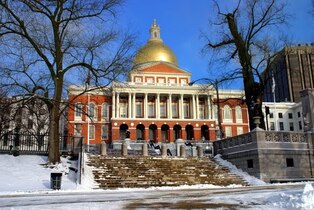
On this bright January morning, as the hour of 11am neared, I emerged from Boston’s Park Street T stop, turned left and began walking up the hill toward the State House. Today (or rather, at this late hour, yesterday) marked the ceremonial signing of the Transgender Equality bill here in Massachusetts. This legislation, first filed in 2007, passed on November 15th, and officially signed on November 23rd, adds gender identity and expression to the state’s existing hate crimes law and the nondiscrimination statutes in the areas of housing, employment, education and credit. In a fitting twist, the week of its official passage was also Transgender Awareness Week, a time of educational and community events leading up to the eleventh annual observance of Trans Day of Remembrance on November 20th. 

The Senate Reading Room, where today’s signing took place, was packed with observers, a joyful crowd savoring the celebration. Lawmakers were clearly also buoyed, as their inspiring comments demonstrated.  “You have no idea how beautiful you are as you stand here beaming,” said state Auditor Suzanne Bump.  “Remember that you are powerful,” offered Senator Brian Downing, followed by fellow Senator Sonia Chang Diaz: “it's days like this that remind us why we ran for office... Thank you for reminding us [legislators] of our own power, in addition to showing us your power.” Representative Byron Rushing, who joined Representative Carl Sciortino in co-sponsoring the bill from its very first days, declared, “this hasn't just been a discussion of gender identity but of the identity of Massachusetts, and hopefully it will become a discussion of our national identity.”  

In his Episcopal Church context, as a longtime member of the Diocese of Massachusetts’ deputation to General Convention– Deputy Rushing inspires us to pose that question of church identity.  Faith communities can ask, and indeed are asking, what do we stand for as people of our respective traditions? In the Episcopal Church we might well ask—and have asked at the 2009 General Convention and various diocesan conventions before it– what does it mean to declare in our baptismal covenant that we strive for justice and respect the dignity of every human being? In 2009 the Convention passed resolutions putting The Episcopal Church on record in support of transgender equality in the civic sphere (D012 and C048), and pledging within our ecclesial life to make administrative forms accessible to gender identities beyond male and female and to protect transgender lay employees from discrimination (D090 and D032, respectively). As our collective conversation continues, we might allow the varied lives of transgender as well as intersex people – communities and individuals whose lives are textured not simply by complex embodiments of gender but also by race, class, sexuality and ability-- to deepen our understanding of the human person. How do we interpret and live out the mystery of being created in the image and likeness of God?

At the signing this morning, I was reminded of a startling moment in the November 15 debate that I watched on my laptop. Representative Sciortino was speaking movingly in support of the legislation when he began to describe the Transgender Day of Remembrance (TDOR) held at the Cathedral Church of St. Paul the year before. He made a point of detailing the apology that my bishop, the Right Rev. M. Thomas Shaw, had offered on behalf of Christians who had condemned trans people and in the process had “misrepresented God to” us. The apology had been stunning enough in its own right, but to hear it reported, in some sense repeated, on the floor of the House of Representatives, was positively astounding. As I sat there dumbfounded—actually, calling out to my partner to come see this!--  receiving these words afresh in an unimagined context, I was reminded of a strangely parallel moment at General Convention three years earlier. The Convention had managed to pass D012, the Trans Civil Rights Resolution, on the same day that the Massachusetts Judiciary Committee was holding a hearing on its own Trans Equality legislation—an earlier version of what has now finally passed. As a team of trans people and allies worked toward the resolution’s passage in Anaheim, a fellow Episcopalian in Massachusetts learned about it (on his laptop, while waiting to testify in the stultifying heat) and shared it in the course of his testimony three thousand miles away. The Episcopal Church supports this bill, he was proud to be able to say.  It all came full circle. 

Also on my mind today were the words (viewable here as blurry video), offered by Bishop Shaw at this year’s TDOR. Speaking at the end of the program, he welcomed us to the Cathedral and then offered a word of gratitude that felt almost like a meditation: “because of your honesty, because of your integrity, because of the way you so pursue the truth of your identity, you tell me about the nature of God, because that is how I think God is. And so I thank all of you not only for the way that you enlighten my understanding of God but how much you preach to the rest of the world about courage, and about bravery, and about truth and about perseverance of identity. We owe all of you a huge debt of gratitude. Thank you.”  

I got the sense people were both honored and stunned by his words, working to digest and contemplate them— I know I was. His comments about perseverance in pursuit of the truth of identity—language I had not heard him use before— reminded me of words from the Gospel of John that I first really took in at a middle school summer Bible camp: “you shall know the truth and the truth shall make you free” (Jn 8:32).  

From this chair, at the end of this day, looking out at the striking vista of falling snow, it strikes me how the process of knowing the truth and being freed by it is both lifelong and communal—by turns grueling and wondrous, and inextricably relational, even as it is distinctive to each person.  

An important truth about the MA trans equality law is that it is far from perfect: it does not include protections in public accommodations—access to public gender segregated spaces. Everyone was resolved to come back and get that done. And as I think about how far we have come, how much more free we are than we were just a few short months ago, I know that what we need more than anything else is the will, the support, the conviction to keep pursuing the truth.

- The Rev'd Dr. Cameron Partridge

Cross-posted at Walking with Integrity

0 Comments

In Massachusetts, An Unfolding Dream

11/15/2011

0 Comments

 
It's been a tense, exciting day in the Boston area as the legislation known as the "Transgender Equal Rights Bill" makes its way out of the Judiciary Committee for the first time in six years.  The bill is heading to the legislature with a vote expected tonight or tomorrow as the winter recess approaches.  

Yesterday the Boston Globe and Boston Herald reported on the impending vote, and this morning both papers reported on dueling press conferences in which the bill's opponents called the vote a "distraction" from economic issues.  When one such representative argued, "The goals of the advocates is to have this litigated in the courts,” he was confronted by Ken and Marcia Garber.  The Garbers' transgender son was, as the Globe explained,"bullied and discriminated against before he lost his life to a drug overdoes at the age of 20." When the representative "said he did not have time to answer their question because he was late to a meeting," the Garbers, faithful members of Dignity Boston, "challenged Lombardo’s contention that the transgender bill is a distraction from bills that would protect the state’s economic future, [saying] 'Some of these people will never have a future if they don’t do something' to pass the legislation."

The trans community had strong victories late last Spring with Connecticut and Nevada added to the ranks of the now fifteen states and 132 counties and cities  with nondiscrimination and hate crimes protections.  

This drama happens to be unfolding during Massachusetts' "Transgender Awareness Week," in which a number of colleges, universities and other community spaces are holding trans-themed events.  The culmination of the week is the twelfth annual observance of the Transgender Day of Remembrance (TDOR).  Though international in scope, the TDOR movement was sparked by a death here in Allston, about a mile away from where I write. Rita Hester was murdered on November 28, 1998 almost three years to the day after the loss of Chanelle Pickett on November 20, 1995. A growing number of Episcopal (and other) congregations have been hosting TDOR events in solidarity with trans communities, even as the observances themselves usually avoid the languages, music or imagery of specific (or at least any one) religious traditions.  Indeed, in his TDOR welcome at a packed Cathedral Church of St. Paul last November, Bishop M. Thomas Shaw offered an apology to the gathered community for the ways in which Christian communities in particular have failed to welcome trans people and have, as he put it, "misrepresented God" to us.  I posted a piece about that TDOR here.

This Sunday the Boston TDOR will take place once again at the Cathedral Church of St. Paul.  

Today Bishop Shaw reiterated his support, that of the Episcopal Diocese of Massachusetts (as of its 2008 Convention), and that of The Episcopal Church (as of the 2009 General Convention) for the legislation. His statement reads, 

"Hopeful that after six years the transgender equal rights bill will come to the Massachusetts Legislature for a vote this week, I continue to urge lawmakers to support it. Now is the time to carry civil liberty for all people another step forward by safeguarding the equality and honoring the human dignity of transgender people. Passing the bill this week will serve as a powerful sign of hope, particularly as Transgender Day of Remembrance is being observed at our Cathedral Church of St. Paul in Boston this Sunday. I pray that Massachusetts will open this new door this week so that we might step through it together toward social justice for all."  

As it so happens, Sunday is also one of the major examples of what I call "hinge days" in the liturgical year, those days in the Christian calendar that form us with peculiar intensity as we move from one liturgical season to the next. November 20th marks the last Sunday after Pentecost, otherwise known as the Feast of Christ the King or the Reign (or, as Verna Dozier might put it, the Dream) of Christ. Sunday's gospel text from Matthew 25 issues the ultimate challenge of justice from the Son of Humanity, enthroned in eschatalogical splendor: will we feed the hungry, clothe the naked, give drink to the thirsty, welcome the stranger, visit the imprisoned?  As we "do it unto the least of these," we "do it unto" Christ, we are reminded with unsettling specificity.  

As the battle over this legislation heats up, I find myself seeking to be present to it as a holy time and space, as an invitation to be, as Bishop Shaw often puts it, opened. It strikes me that this openness is not simply a static state of welcome and inclusion, but an ongoing process of being opened, transformed by God, ushered into new ways of being in the world, into a new time and space that Christians name as the reign or dream of God. That notion of openness is unsettling and challenging indeed, but hopeful and promising beyond our wildest imaginings. May it be—may it become – so.

- The Rev'd Dr. Cameron Partridge
0 Comments

Chaz on Becoming

5/13/2011

0 Comments

 
In a banner week in which the governor of Hawaii signed a workplace nondiscrimination bill into law, and in which the legislature in Nevada is debating a similar measure, the biggest transgender-related news is coming from Chaz Bono. That’s because the documentary about his transition, Becoming Chaz, premiered Tuesday night on the Oprah Winfrey Network, and Chaz has been everywhere this week promoting it.

The few reviews I’ve read have found their way into the film via people other than Chaz. His partner Jennifer has been a fascinating figure for some, and Cher has for others. I haven’t read any reflections on his siblings, but they would be bridge figures for still other viewers of the film like, say, my sister. It makes sense—if you’re not trans (and even if you are), you might have a hard time relating to Chaz, but you could more easily imagine yourself in the position of those who have a relationship with him.  

But as a trans man myself, Chaz was the one on which I knew I would be primarily focused. Because he’s the son of celebrities, having grown up under completely different circumstances than did I or anyone I know, I honestly wasn’t sure how well I would relate. More than that, I was concerned that because of its celebrity connections, this film had the potential to feed into the mass media’s sensationalistic appetites. Given all that, I was fascinated how little this film actually does falls into that trap, and how Chaz and Jenny come across as remarkably down to earth and authentic, very human amid a fair bit of drama. Chaz is very clearly and simply himself, take it or leave it. So too is Jennifer. The two of them have been through a lot both individually and as a couple, and they’re remarkably honest about that.  

I was intrigued — and oddly relieved — to hear that there nevertheless were aspects of the film that stretched their own comfort zones when they saw it after the fact. In the interview with Rosie O’Donnell after the Oprah channel premier, Chaz talked about the difficulty at first of seeing an argument that unfolded over kitchen preparations for Jenny’s graduation party. But then as he watched it again, he came to see the argument as a real portrayal of where he and Jenny were at that moment. That comment to O’Donnell conveyed a revealing sense of perspective, a sense that Chaz knows he was in a different space then and will be in a still different one down the road. Comments like those suggest to me that he takes his “becoming” very seriously, and in a much broader and deeper sense than transition alone.

Chaz has been through some seriously choppy life waters, and while he doesn’t put it this way, his remarks about previous eras of his life suggest that he has had to make a practice of seeking perspective. He has had to make a practice of accepting himself for who he is. When he said at one point that he didn’t want to lose anyone because of his decision to transition but knew that he had to make the decision regardless, I thought, yeah, I know what you’re talking about. You don’t get to a place like that, you don’t arrive at such a crossroad, without having done a ton of work-- discernment. 

I also appreciated how Chaz did not present himself as speaking for every trans man, let alone every trans person. In one scene, as he spoke at what I believe was a Transgender Day of Remembrance event in West Hollywood, I was impressed with the way he got up and described himself as a newcomer to the community, not presuming to speak for others, and acknowledging that tons of organizing and community building had preceded his arrival on the scene, in many ways making that arrival possible.  

That said, there were some assertions in the film with which I disagreed. The misleading graphic listing the side-effects of testosterone failed to distinguish those that affect trans men alone (e.g. the need to monitor liver function) from those that all non trans men have to watch (e.g. cholesterol). I wasn't crazy about the film's repeated use of “breast removal” language; as a result, many reviewers are now using it in a way that can subtly reinforce the judgment that this surgery is merely a form of “amputation” (or, worse, “mutilation"). Simply sticking to the term “chest reconstruction” would have been more straight forward. Chaz also made a few universalizing comments about the relational effects of testosterone, saying things about his insights into male/female difference that reminded me of remarks I once heard on the infamous testosterone episode of This American Life. All I could think was, Stop! Don’t go there! Trans folks don’t know any more about what “really” differentiates the sexes, where “really” means “biologically,” than anyone else. What I think we do have a chance to see at particularly close range is how gender gets culturally organized, how intricately, concretely, differentially, intersectionally each of us is woven into an ever-shifting socio-cultural fabric. 

There is so much more to say about this powerful film—more than I have time to write here. But the final thread I find myself pondering is that of narratives—with what stories we narrate our origins, the origins of our self-awareness, the origins of our decisions. Again and again, we were shown images of Chaz as a child on TV with Sonny and Cher, images that had the effect of asking the viewer to consider the narrative s/he supplied for that child. It makes me wonder, what narratives do we assume or project onto one another? How do we shift those narratives when our expectations are subverted? But that then raises the larger question, how do we narrate change without assuming the process moves in a straight line? There is something crucial about what it is to be human that is captured by Chaz’s process of becoming. Not only does it raise the question of how sexual difference fits into—indeed might change — one’s conception of the human person. It also asks us all, trans and non-trans, to consider how the process of becoming itself, how transformation, grounds and indeed defines our humanity.  

- The Rev'd Dr. Cameron Partridge
0 Comments

Easter People in a Good Friday World

5/1/2011

0 Comments

 
Cross-posted from the Walking with Integrity Blog:

Retired Bishop Barbara C. Harris has a saying that we are “an Easter people in a Good Friday world.” That’s what I find myself pondering as I think of the current state of affairs for trans people in the U.S. right now. If we are an Easter people—an Easter body—we are, as tomorrow’s passage from John 20 so strikingly depicts it, a risen body marked by wounds that remain open.

The U.S. trans community got some good news this week when the Department of Labor announced it has added "gender identity" to its equal employment statement. The National Gay and Lesbian Task Force's press release on the addition can be found here.  

We also got some good news two weeks ago when the state legislature of Hawaii sent legislation to Governor Neil Abercrombi that would protect trans people in the area of employment. On Monday, April 18th, Hawaii’s House of Representatives passed Bill #546 which, as the Star Advertiser explained, “would bar employers from discriminating on the basis of gender expression, bringing Hawaii's labor law in line with similar protections in the areas of housing and public accommodations.” The governor is widely expected to sign this legislation.

That Hawaii already protects trans people from discrimination in several areas, particularly access to public accommodations, is also significant. In other states, public accommodations access is being hotly debated, with opponents of equal access often caustically terming such legislation “bathroom bills.” The specter these opponents raise in such debates is of vulnerable women and children being open to attack in women’s restrooms—if not by trans people, then by people posing as trans. With such fear tactics, they seek either to prevent the passage of laws that would safeguard trans access to public accommodations, or they seek to repeal legislation already on the books.  

The state of Maine is currently considering just such a repeal, as shown by Integrity Maine member Ben Garren’s recent testimony against that repeal effort.

As of Monday, Texas became the home of another repeal effort, this one attempting to prevent trans people from marrying. As Bay Windows reported earlier this week, “The legislation…. would prohibit county and district clerks from using a court order recognizing a sex change as documentation to get married, effectively requiring the state to recognize a 1999 state appeals court decision that said in cases of marriage, gender is assigned at birth and sticks with a person throughout their life even if they have a sex change.” In addition to preventing future marriages, this legislation may well undermine the legal standing of existing ones—my own, for instance, if I lived in Texas.

Meanwhile on April 11th in Maryland, the Gender-Identity Discrimination Act (House Bill 235—which addressed employment but left out public accommodations) was effectively killed for the current legislative year when it was narrowly voted back to the state’s Judiciary Proceedings Committee. As the Baltimore Sun reported, “While the bill was being debated on the House floor, one delegate alluded to Cpl. Klinger, a comic-relief character from the TV show "M*A*S*H" known for wearing women's clothes while trying to get a psychiatric discharge from the Army. The delegate wanted to know if his colleagues wanted Klinger leading a day care center.”  

On April 18th, one week after the bill was killed, a young trans woman named Chrissy Lee Polis was attacked by young non-trans women as she tried to enter a bathroom in a Baltimore MacDonald’s. The story of the beating, including a video taken by a MacDonald’s employee -- in which Polis can be heard asking “what bathroom am I supposed to use?!” -- went viral in the days that followed (youtube has now removed it). This story has been covered everywhere, from this call to action by Chris Paige of TransFaith online to an NPR story yesterday and a Washington Post piece earlier this week. A Baltimore Sun story from earlier today considers whether perhaps this horrifying event may be a moment we look back upon as a turning point. 

As TransEpiscopal co-founder Donna Cartwright put it in a letter to the editor of the New York Times today, “Defiance of rigid cultural gender expectations still makes many people uncomfortable, and all too often we pay the price for others’ discomfort.” Nevertheless, she continues, “we can create new cultural space by being who we are, without apology.”

When I think about the process of creating that “new cultural space,” I can’t help but be reminded of the mystical theology of Julian of Norwich, whose feast day falls on May 8th. I think of her vision of the body of Christ, its side mystically opened to all as to Thomas in the upper room—opened in a strangely infinite capacity as a place of refuge, a body of transformation, a passage of rebirth.  

An Easter people in a Good Friday world indeed.

-The Rev'd Dr. Cameron Partridge
0 Comments

Trans Faith Action Week Launches

4/5/2011

0 Comments

 
Picture
Cross-posted from the Walking With Integrity blog:

Yesterday I participated in a press conference at the Massachusetts State House in which religious leaders called for the passage of "An Act Relative to Transgender Equal Rights," a bill that would add "gender identity and expression" to existing nondiscrimination legislation in Massachusetts. For the past three years this bill has failed to make it out of committee, despite a great deal of support in the legislature and from the governor. The main speakers at the press conference were the Right Reverend M. Thomas Shaw, SSJE, the Bishop of the Episcopal Diocese of Massachusetts; Sean Delmore, an openly transgender man who is the Assistant Minister at College Avenue United Methodist Church (Somerville) and a member of  Cambridge Welcoming Ministries, and a candidate for the diaconate in the United Methodist Church; and Rabbi Joseph Berman of Temple B’nai Israel in Revere, MA. The press conference was part of a weeklong effort, dubbed by the Interfaith Coalition for Transgender Equality and the Massachusetts Transgender Political Coalition as "Transgender Faith Action Week," a week in which congregations from various religious traditions are calling for transgender equality.

An article by Lisa Wangsness about yesterday's press conference was on the front page of the Metro Section in this morning's Boston Globe, and is pasted below (the above photo by David L. Ryan was taken from it). This article comes on the heels of last week's Guardian article by Becky Garrison, which featured interviews with a number of transgender clergy in the United States and the United Kingdom. In the UK, as Rev. Dr. Christina Beardsley has explained in a series of blog posts for Changing Attitude, the week of March 21st featured seven short video interviews by 4thought.tv on Channel 4 (unfortunately not available for viewing outside the UK) at the intersection of transgender and religious identities. Garrison's article pointed back toward the UK video series and forward toward Trans Faith Action Week, here in Massachusetts.

CP

Here is today's Globe story:

Religious leaders revive bid to pass transgender bill

Bishop M. Thomas Shaw of the Episcopal Diocese of Massachusetts and several other clergy yesterday called on Massachusetts lawmakers to pass transgender-rights legislation and asked religious communities to throw their support behind the bill.

Shaw said that virtually all transgender people have experienced discrimination or harassment and about one-quarter have been fired from their jobs.

“Supporting this legislation, and supporting transgender people in the life of the church and in secular society really has to do with the living out of my baptismal covenant,’’ he said.

The bill would prohibit discrimination in Massachusetts against transgender people in employment, housing, public accommodations, education, and credit, and would expand the hate-crimes statute. Thirteen states and more than 130 cities nationwide have passed similar legislation.

A majority of lawmakers in both the House and Senate cosponsored the bill last year, but it never came up for a vote. Representative Carl M. Sciortino Jr. of Medford, a lead sponsor, said the political climate changed dramatically after Scott Brown won the special election for US Senate in January 2010.

“The level of willingness to take up controversial votes diminished after that,’’ Sciortino said.

The issue became particularly charged a year ago, when Republican gubernatorial nominee Charles Baker derided the legislation as “the bathroom bill,’’ a term opponents use to reflect their belief that it would give sex offenders greater access to children in public bathrooms by effectively making the facilities unisex. Supporters of the bill say that is not true: People would still have to use bathrooms that match the gender they present.

Kris Mineau of the Massachusetts Family Institute, which opposes the bill, said yesterday that his organization remains concerned about “the privacy, safety, and modesty of all citizens.’’ He said there is no need to broaden the state’s nondiscrimination and hate-crimes statutes.

He noted that the number of sponsors had declined markedly this year — from 81 to 52 in the House and from 23 to 16 in the Senate, according to the website of the Massachusetts Transgender Political Coalition.

Gunner Scott, the coalition’s executive director, said 35 former cosponsors either did not run again or were not reelected. Supporters of the legislation are talking to freshmen and hope to find additional support, he said, adding that the bill still has more cosponsors than about 95 percent of other bills.

Governor Deval Patrick also backs the legislation and this winter issued an executive order protecting transgender state employees from discrimination.

Representative Byron Rushing, another lead sponsor, said religious groups supporting gay rights showed their political strength in 2007 when they helped defeat a proposed ban on gay marriage. “I think what religious groups offer is their theological perspective on justice . . . but it’s also very important that we hear from those denominations that have begun to end discrimination against transgender people within their own denomination,’’ he said.

Other religious groups, including the Massachusetts Conference of Catholic Bishops, fought against the gay marriage bill in 2007. The bishops also opposed the transgender legislation last year.

About 135 clergy are publicly supporting the bill this year, according to the Interfaith Coalition for Transgender Equality. The coalition this week is asking congregations to work for its passage. Appearing with Shaw yesterday were the Rev. Cameron Partridge, a transgender man who is interim Episcopal chaplain at Harvard; Rabbi Joseph Berman of Temple B’nai Israel in Revere; and Sean Delmore, a transgender man who is assistant minister at the College Avenue United Methodist Church in Somerville.

Shaw acknowledged that it might be tougher to rally as large a coalition for transgender rights as for gay marriage, if only because relatively few heterosexual people know someone who is transgender.

Getting to know transgender people personally, he said, has “taken me deeper into my own faith life and proved to me once again that unless everyone has equality . . . nobody is really free.’’


And here is last week's Guardian story:

Trans clergy are finally gaining greater acceptance
As we approach Transgender Faith Action Week, progress can be seen in attitudes to trans people within the church

Becky Garrison
guardian.co.uk, Wednesday 30 March 2011 18.04 BST

Last week, the Rev Dr Christina Beardsley, vice-chair of Changing Attitude, a network of lesbian, gay, bisexual, transgender and heterosexual members of the Church of England, was one of the voices featured on 4Thought.tv's week of short films featuring trans people and faith.

While the US Episcopal church developed a maverick reputation within the Anglican communion for blessing same sex marriages and ordaining gay and lesbian clergy, the House of Bishops of the General Synod of the Church of England's report Some Issues in Human Sexuality, issued in 2003, contained a chapter titled "Transsexualism". Currently, one can find about a half dozen trans clergy in the UK and US. These numbers are imprecise, as some clergy do not wish to go public beyond the scope of their individual parish or diocese – a concern that's understandable given that the trans community seldom receives even the legal protections afforded gays and lesbians .

Beardsley, who was ordained for 23 years prior to her transition in 2001, observes that "some within the Church of England feel the issue of trans clergy has been settled" by citing such cases as the Rev Carol Stone and the Rev Sarah Jones. However, she says: "Not all trans clergy have been supported by their bishop, as these two priests were, and some have been excluded from full-time ministry because of Church of England opt-outs from UK equality legislation."

During the 2008 Lambeth conference, a decennial gathering of Anglican bishops, Beardsley organised a panel titled "Listening to Trans People". While only four bishops attended this gathering, it represented the highest number of bishops to participate in an Inclusive Network to date. Also, this panel helped consolidate Changing Attitude's networking with Sibyls, a UK-based Christian spirituality group for trans people, and the US-based online community TransEpsicopal.

The Rev Dr Cameron Partridge, interim Episcopal chaplain and lecturer at Harvard University, served on this panel as the sole US representative. He transitioned in 2002 during his ordination process and has been an instrumental player in guiding the passage of four resolutions supporting trans rights during the US Episcopal church's 2009 general convention.

The Rev Vicki Gray, a Vietnam vet before her transition, and currently a deacon with an emphasis on ministry to the homeless, noted that their goals at general convention were to assert that we exist as flesh-and-blood human beings, to demonstrate that we are here in the church as decent and devout followers of Jesus Christ, and to begin the process of education and dialogue that will lead to full inclusion in the life of the church, not only of the transgendered but of other sexual minorities such as the inter-sexed (known to some as hermaphrodites).

Following the murder of trans rocker Rita Hester in Allston, Massachusetts, in 1998, a vigil held in her honour became the impetus behind the International Transgender Day of Remembrance, an annual event held on 20 November. Even though this day to reflect and remember those who have been killed by anti-transgender hatred or prejudice is not a religious service, in 2010 memorial services were held for the first time at Episcopal cathedrals in Boston and Sacramento.

The Rev Christopher Fike, vicar of Christ Episcopal Church in Sommerville, Massachusetts, who transitioned in 2003 after having served in a fairly high-profile position as a female cleric, believes that moving this memorial to the cathedral signifies that the church views this as a justice issue. He says: "The more we normalise people who are outside the typical in their gender expression, the more room there is for that range of expression. We no longer have to hide our real identity from the church."

The Rt Rev M Thomas Shaw, SSJE, Bishop of Massachusetts, admits that ordaining and providing pastoral oversight to trans clergy proved to be a life-changing experience for him. Initially, he struggled with the idea and the reality of having trans clergy until he saw they were doing the same ministry as everyone else.

From 3-10 April, Transgender Faith Action Week will be held in the Boston area in the hope of bringing forth faith leaders from different traditions to increase awareness of the trans community in religious circles. Partridge, one of the organisers, says: "We call upon the church to consider carefully its vision of theological anthropology, its theological vision of the human person. How does gender factor into our conception of the human?" After all, in Genesis 1:26, God created ha-adam, a nonsexual term that means "human being". Then, after he created humanity, she declared that it all was "very good".

0 Comments

Sonia Burgess (1947-2010)

3/15/2011

0 Comments

 
Picture
Although it happened almost six months ago many people here in the UK are still devastated by the sudden death of Sonia Burgess. The circumstances were incredibly shocking. On Monday 25th October 2010 Sonia was on her way to a lecture at St Martin-in-the-Fields. She had attended the previous talks in the series ‘Bible Opened for All’ and on this occasion Lucy Winkett would speak about ‘Being Biblical, Being a Woman’. The topic would have been of particular interest to Sonia, who had at this stage in her life lived mainly, though not quite exclusively, as a woman; but Sonia would never hear this talk. She was seen arriving on the underground platform at Kings Cross Station just prior to 6.30pm, accompanied by a younger woman, with whom she was talking excitedly. Within minutes Sonia fell to her death in the path of the arriving train. Her companion, Nina Kanagasingham, also a trans woman, was arrested at the scene on a murder charge and taken to a male prison. Her trial is scheduled for July. 

Sonia was a friend. I had met her in January 2009 at a Rainbow Space (the LGBT group) event at St Anne’s Church, Soho, London, which was the church she belonged to at that time. Warm-hearted, petite and pretty, she seemed younger than me, though in fact she was a few years older, and she communicated well with the young trans people who had joined us for the meeting. When we chatted afterwards Sonia was somewhat apologetic about the fact that she still worked in male mode ‘as a human rights lawyer’. I remember saying that her job sounded demanding; she nodded but was in no way forthcoming about her work. I encouraged her to join Sibyls – the UK organisation that promotes Christian Spirituality for Transgender People – which she did, and I had the pleasure of meeting her at the bi-monthly meetings in London when Sibyls gather for prayer followed by a meal. The last time we spoke, at one of these occasions, I discovered that she had been brought up in the north of England, as I was, and that she had studied in Cambridge, a few years ahead of me. Slim and fashionably dressed – she had just been shopping at Zara – it was hard to believe that she was in her early sixties, and once again I saw her rapport with the young (in particular, a new Sibyls member who is also disabled).

So when, in late October 2010, headlines began to appear in the newspapers about a ‘man in a dress’ or ‘transvestite’ who had (allegedly) been ‘“pushed” under train’ never for a moment did I think that they were referring to Sonia. Although I knew that Sonia worked in male mode, I had not met ‘David’ (nor had most of David’s colleagues ever met Sonia), but in any case, to me, as to her many friends, including those at St Martin-in-the-Fields where she had begun to worship, she was a woman, kindly and vivacious: Sonia. Indeed, early reports of her death referred to her correctly as ‘a woman’; it was only when the police discovered documents on her person that related to her male identity that the crude and inaccurate headlines began to appear. The British press has a long-standing habit of sensationalising trans people’s lives, but on this occasion there was a huge outcry in protest, led by Trans Media Watch, which only this week gathered journalists from the press and television to launch its Memorandum of Understanding which seeks to improve the coverage of transgender people and issues in the media. It comes too late for Sonia, but the handling of her story by the media has been the focus for an important discussion about the need for greater sensitivity and respect when discussing transgender people’s lives. 

After the breaking news of the death of a transgender woman came the shock, for her friends, of hearing that it was Sonia. Nowhere, apart from her family, was the grief more deeply felt than by the congregation at St Martin-in-the-Fields, where a meeting was called and a vast number of people gathered, along with her children, to share their memories of Sonia – and of David. One friend who attended it told me that the use of both male and female names and pronouns didn’t seem to matter as people spoke about their love and admiration for this remarkable person.

It was only at this point that David’s extraordinary career as the leading immigration lawyer of his generation became known to those of us who knew only Sonia, as well as his role in landmark cases that had led to greater transgender equality in the UK. One might have expected Sonia to mention the latter, if not the former, to trans friends and acquaintances, but such was her modesty that she never spoke of either! You can read more about her life, as David, and as Sonia, in the links that follow. Journalist Elizabeth Day’s sensitive article was written earlier this year to give a more rounded picture of Sonia/David in contrast to the sensational tabloid versions. Legal academic and trans activist Stephen Whittle knew Sonia professionally, and as a friend, over many years, and his obituary of her, written at the time, is passionate and revealing. My own brief post about Sonia, on the Changing Attitude blog, reflects on her death from a spiritual perspective, and, as you’ll have gathered, her Christian faith was important to her. 

- The Rev'd Dr. Christina Beardsley 15.03.11

Rev. Dr. Christina Beardsley is on the Board of Changing Attitude, which works for the full inclusion of gay, lesbian, bisexual and transgender people in the life of the Anglican Communion.

Picture
0 Comments

Winter Thaw for Trans Equality

2/24/2011

0 Comments

 
We are at the end of February, and this year’s very long season of Epiphany is almost at an end as well. Here in the Boston area, side streets are still littered with chairs and other detritus-- markers of the you-shovel-it-you-keep-it parking culture-- but snow banks are finally showing signs of letting go. Last week the state’s transgender community also received welcome news that perhaps the long-frozen nondiscrimination bill, too, might be starting to thaw.  

As recently posted on Walking with Integrity, last week Governor Deval Patrick signed an executive order banning discrimination on the basis of gender identity and expression for all who work for the Commonwealth of Massachusetts. The Boston Globe both reported on the move and published an editorial praising it, and yesterday the local LGBT paper Bay Windows published a comprehensive article on it as well.

As reported in all three pieces, this development both creates a sense of momentum for the statewide bill which would add "gender identity and expression" to the categories of age, race, creed, color, national origin, sexual orientation, sex, and marital status, and prevent discrimination on those bases in employment as well as in housing, public accommodations, education, and credit. 

The dire need for this protection was just underscored by the major new study, the National Transgender Discrimination Survey, released on February 4th by the National Gay and Lesbian Task Force and the National Center for Transgender Equality. They surveyed over 6,450 transgender-identified participants and learned the following, as summarized on NCTE's website:

"* Respondents were nearly four times more likely to live in extreme poverty, with household income of less than $10,000.

* Respondents were twice as likely to be unemployed compared to the population as a whole. Half of those surveyed reported experiencing harassment or other mistreatment in the workplace, and one in four were fired because of their gender identity or expression.

* While discrimination was pervasive for the entire sample, it was particularly pronounced for people of color. African-American transgender respondents fared far worse than all others in many areas studied.

* Housing discrimination was also common. 19% reported being refused a home or apartment and 11% reported being evicted because of their gender identity or expression. One in five respondents experienced homelessness because of their gender identity or expression.

* An astonishing 41% of respondents reported attempting suicide, compared to only 1.6% of the general population.

* Discrimination in health care and poor health outcomes were frequently experienced by respondents. 19% reported being refused care due to bias against transgender or gender-nonconforming people, with this figure even higher for respondents of color. Respondents also had over four times the national average of HIV infection.

* Harassment by law enforcement was reported by 22% of respondents and nearly half were uncomfortable seeking police assistance.

* Despite the hardships they often face, transgender and gender non-conforming persons persevere. Over 78% reported feeling more comfortable at work and their performance improving after transitioning, despite the same levels of harassment in the workplace."

An interview from the Bay Windows story shows both some of the unexpected ways that people's transgender status can come up in an employment application process and the reality that there are indeed workplaces where people are free to do their jobs and be themselves. Diane DeLap, who works for the Department of Workforce Development, explained how her application process inadvertently revealed her transgender status to her prospective employer: "'One of the interesting things was that the Massachusetts Employment Application requires the inclusion of discharge papers if you have a history in the military,' DeLap said. She had served in the Navy for four years, and included her discharge papers with her application. 'Of course, the military doesn’t change names for anything,' DeLap said, laughing, 'so it had my old name on there and all the other papers had the new name on there, so the fact that I was transgender became a topic of discussion very early in the hiring process. They determined that it shouldn’t make any difference.'"

DeLap clearly had a good experience in her interview process, and others I know also have had positive experiences coming out at work. Increasingly, there is good news of that sort to tell, and it is important to share it along with the alarming statistics and stories, as both are realities right now. The latter tells us how much work we have to do while the former encourages us that it has already begun and we can indeed do it.

As with marriage equality, which received a major boost from the Obama administration this week, I am hopeful that the ice is truly beginning to thaw for transgender equality, that momentum is finally building toward passage of key legal protections. It is up to us to keep that momentum going.

The executive summary of the NCTE/NGLTF survey can be found here, and the full report here.

- The Rev'd Dr. Cameron Partridge

This post was cross posted from 
Walking with Integrity
0 Comments

Stirring Letter from a Retired Bishop

12/21/2010

0 Comments

 
As I scanned the letters to the editor in the Boston Globe this morning, I was happily surprised to come across one by the retired bishop of Ohio, the Right Reverend J. Clark Grew, who now lives in Boston.  

It reads as follows:

Gay themes tend to stir wrath of some on Capitol Hill
December 21, 2010

I WRITE to thank Sebastian Smee for his excellent Dec. 16 piece “Offensive? ICA lets the public decide,’’ about the removal of a video from a gay-themed exhibition at the National Portrait Gallery. It is a sad occasion when art in our country’s museums, much less anywhere else, is subjected to the political and religious right’s blatantly homophobic manipulations.

I agree with Smee’s emphasis that the public should decide what is or isn’t art, but there is another article that needs to be written, and that is one about the ongoing and increasingly nasty gay-lesbian-transgender-bashing that is so prevalent with some members of Congress.

The Right Rev. J. Clark Grew, Boston 

The writer is a retired bishop in the Episcopal Church.


The Globe editorial that Bishop Grew refers to responds to the decision by Boston's Institute for Contemporary Art (and several other museums around the country) to show a video installation that was removed December 1st from an exhibit at the Smithsonian's National Portrait Gallery entitled "Hide/Seek: Difference and Desire in American Portraiture." On the Smithsonian's website, the exhibit is described as "the first major museum exhibition to focus on sexual difference in the making of modern American portraiture," considering "such themes as the role of sexual difference in depicting modern America; how artists explored the fluidity of sexuality and gender; how major themes in modern art—especially abstraction—were influenced by social marginalization; and how art reflected society’s evolving and changing attitudes toward sexuality, desire, and romantic attachment."

The offending video was created by New York based artist David Wojnarowicz (1954-1992) in 1986-87 in response to the death of his partner, Peter Hujar, from AIDS-related complications, and from his own diagnosis with the virus that would ultimately take his life at the age of 37. The Smithsonian's version of the video (now having gone viral on youtube in the wake of this debate), which Smee describes as "a four-minute, surrealistic montage of footage shot in Mexico called 'Fire in My Belly,’" includes, among a number of other images, "intermittently recurring footage of ants crawling on a small painted crucifix that lies on the ground." Smee goes on to point out, "when it comes to representations of Christ’s death, the Christian tradition is full of base and wretched imagery, as anyone who has seen Matthias Grünewald’s shudderingly graphic 'Isenheim Altarpiece' in Colmar, France, or for that matter Mel Gibson’s movie 'The Passion,’ would know."

The Smithsonian decided to remove the video after being pressured by members of Congress and the president of the Catholic League, Bill Donohue. As Jacqueline Trescott reports in the Washington Post, the significance of this "skirmish" is that it "could forecast a renewed battle over arts funding when the Republican-led House takes over in January." Hollad Collard also notes in the New York Times that in this episode, "history is repeating itself, with variations;" in 1989, Wojnarowicz won a suit against Donald Wildmon, a Methodist minister who had disseminated to members of Congress a pamphlet with selective images from Wojnarowicz's collages, targeting his partial support by the National Endowment for the Arts.  

Wojnarowicz may no longer be able to defend his work, but plenty of people are stepping into the fray.  

Noting the protests that have proliferated since the removal of the video, Bill Donohue has now commented in a December 17th press release, "The artist who gave us the ant-crawling video, David Wojnarowicz, died of AIDS. So did his lover, Peter Hujar. Mapplethorpe died of AIDS, too. And now those who adore them are taking to the streets on their behalf. Think I'll just watch the Giants—kickoff is at 1:00 p.m."

Reading this comment, just days after the Senate's historic vote to repeal Don't Ask, Don't Tell, it's impossible not to be reminded how much the struggle continues. And a huge part of that struggle is making sure that "the church" or "the religious" does not get monolithically represented by such voices. 

Which brings me back to the profound sense of gratitude I felt this morning when Bishop Grew's letter showed up on my front porch, like a surprise Christmas present wrapped up in a newspaper.

The story of this video skirmish may feel more like Lent than Christmas, and yet in the end to me it serves as a reminder of the messiness of Incarnation, and of the critical importance of solidarity and hope in a season of intense joy and need.

- The Rev'd Dr. Cameron Partridge
0 Comments

The Rev'd David Weekley on Reviving the Conversation

12/13/2010

0 Comments

 
PictureThe Rev. David Weekley prepares the elements for Holy Communion on his first Sunday morning at Sellwood United Methodist Church in Portland, Ore. A UMNS photo by Tina Todd, Sellwood UMC.
This article and its photos are reposted from the United Methodist Church's media page, under the heading "Transgender Pastor Urges Sexuality Debate". Rev. David Weekley, whom I met at the Philadelphia Trans-Health Conference in 2009, is one of at least two ordained transgender ministers in the United Methodist Church.  

A UMNS Report
By Linda Bloom*

1:00 P.M. EST Nov. 18, 2010

The Rev. David Weekley thinks it’s difficult for the church to have meaningful conversations about sexual and gender identity.

So, for years, the Portland, Ore.,-based United Methodist pastor, husband and father of five kept his own secret about having been born a girl but never feeling like one. Then, on Aug. 30, 2009, he decided it was time to start telling the story of his experience as a transgender man, beginning with his own congregation.

Now, Weekley wants to widen the discussion about sexuality throughout the denomination, despite what he perceives as an increasing reluctance to discuss such issues. The recent refusal of the United Methodist Judicial Council to reconsider its 2005 decision upholding a pastor’s right to reject someone as a member of his church is an indication of the urgent need for conversation, he said.

He has even written a book about his own experience, now in the final editing stages, which he hopes can be used as a conversation starter once it is published by Wipf and Stock of Eugene, Ore.

Some church members believe there has been more than enough conversation on the topic. The Rev. Thomas Lambrecht, a United Methodist pastor from Wisconsin and a representative of Good News, an unofficial United Methodist evangelical caucus, said “the continued focus on sexuality issues” is a reflection of western culture rather than a theological imperative.

“What we need to focus on is becoming disciples of Jesus Christ and living that out in a variety of ways,” he added.

Conversation, however, can take issues of sexuality out of the cerebral and into the personal, says the Rev. Troy Plummer, executive director of the Reconciling Ministries Network. While some segments of society, as well as some churches, are having those conversations, “it mostly feels like the church wants to avoid conflict and discomfort” on issues of sexuality, he noted.

Such discomfort is familiar to Weekley, one of the few transgender pastors in The United Methodist Church. The denomination’s book of law currently has no prohibitions against ordaining transgender persons, and Weekley remains in good standing with the Oregon-Idaho Annual (regional) Conference.

Making the change

His own transformation – from female to male and from alienated Christian to ordained pastor – began in 1972, when the 21-year-old started the gender-reassignment process at University Hospitals in Cleveland. After completing the medical transition in 1975, he attended graduate school at Miami University of Ohio and started searching for a faith community.

Walking into a United Methodist congregation in Oxford, Ohio, and, like John Wesley, finding “my own strange warming of the heart experience there” on World Communion Sunday was the first step in Weekley’s faith journey, he recalled.

The journey took him from serving as a volunteer at the campus ministry center to studying at Boston University School of Theology to beginning the ordination process in 1982. He became an elder in the Oregon-Idaho Conference in 1984.

Weekley said he never buried his former identity, but often wrestled with the issue of when and how he should share his story.

“One of my hopes was by working quietly with people, trying to be a good pastor, it would give people a lot of opportunity to get to know me as a pastor.” Then, when he did share his story, he reasoned, “it would have a positive impact.”

A 2008 pilgrimage to Minidoka, a World War II internment camp in Idaho – with members of Weekley’s mostly Japanese-American congregation at Epworth United Methodist Church in Portland – made him start to think it might be the right time to go public about being a transgender man, especially since his children were now young adults and able to understand it.

“At the internment camp, I saw the impact of being able to talk about their lives and laugh and cry together about their experiences,” he said. “That congregation seemed like a place that could resonate with my experience.”

Indeed, the congregational support was immediate. “The day of the service, people broke into applause at the end of my message.” Later, however, a small group of members seemed to complain more often to him. “I was never sure whether it had to do with my being transgender and sharing that … but it eventually led to my decision that it was best to move,” he said.

Reviving the conversation

Today, Weekley appreciates being in a two-point charge – Sellwood and Capitol Hill churches in Portland – where members were aware of his transgender identity right from the start.

Since his revelations in 2009, the transgender pastor has received hundreds of responses “from people all over the country, even outside the country, telling their stories to me, thanking me for speaking for them.”

What troubles him is probably 90 percent “had their own stories of feeling estranged and alienated from their faith communities.”

Weekley was disappointed when the denomination’s top court declined to reconsider Judicial Council Decision 1032 at the end of October. Decision 1032 stated that a United Methodist pastor has the right to determine local church membership, even if the decision is based on the person’s sexual orientation.

While he understands not wanting to usurp the authority of the pastor, “when I think about the bigger picture, I wonder if the case would have been the same if it had been about ethnicity or race or gender,” he said.

“As a pastor, I can’t imagine telling someone who wants to be part of our faith community that they weren’t welcome,” he added.

Lambrecht, who had participated in the Judicial Council’s oral hearings on the matter, said he felt the council acted with integrity “in terms of upholding church law and recognizing the separation of powers between the legislative and judicial areas of our church.”

Evangelicals are satisfied with the church’s current positions on human sexuality, he said, but he expects that efforts will be made to change those positions at the denomination’s 2012 legislative assembly.

“The continued discussion of this issue, we feel, detracts from focusing on more important issues like the Call to Action report and the movement of encouraging vital congregations,” Lambrecht said.

The Reconciling Ministries Network, an unofficial group that advocates for United Methodists of all sexual orientations, filed briefs related to several of the petitions before the Judicial Council. Plummer argued on the organization’s website that undoing a judicial decision such as Decision 1032 falls within the bounds of the council’s work.

“This intentional refusal to right an obvious wrong is the latest act of discriminating hurt directed by The UMC toward LGBT (lesbian, gay, bisexual and transgender) people,” he declared.

Weekley wishes the denominational discussion on sexual identity would adhere more closely to the Wesleyan quadrilateral, which uses scripture, tradition, reason and experience as a basis for theological reflection.

He believes the church is ignoring the current scientific research related to the issue of choice and the origins of sexual orientation and gender identity. “It seems that reason and experience are missing from this conversation,” he said.

*Bloom is a United Methodist News Service multimedia reporter based in New York. Follow her at http://twitter.com/umcscribe.

News media contact: Linda Bloom, New York, (646) 369-3759 or [email protected].

0 Comments

Light Shining in the Darkness: Transgender Day of Remembrance in Boston

11/21/2010

0 Comments

 
Early yesterday evening, as the nearly full moon rose above the Boston Common, my partner, our thirteen-month-old and I headed to dinner with a friend and then wandered around the corner for Transgender Day of Remembrance (TDOR). Upon arriving at the Cathedral Church of St. Paul, I was amazed at how many people were already there, even a half hour before the start of the event. Before the night was over, between 325-350 people would crowd into the space, including the balcony (and I got those numbers from the ultimate source, Jim Woodworth, one of the cathedral’s longtime sextons). 

One of my favorite things about TDOR is the way it draws people together—I love touching base with people I haven’t seen in a while, and this year I was struck by the variety of contexts from which I knew people: from the Greater Boston trans community, current and former students, and Episcopalians from the Diocese of Massachusetts. In the latter category was the Reverend Stephanie Spellers, priest and lead organizer of the Crossing, and Penny Larson, drummer for the music team of the Crossing, which for the second year in a row hosted an open mic on Thursday for the local collaborative “Transcriptions.” Penny gave some very moving remarks later in the event, which are reposted below.  

Also present at TDOR for the first time this year was my bishop, the Right Reverend M. Thomas Shaw III. He had just come from a Eucharist celebrating the 100th anniversary of the clothing of the sisters of St. Anne-Bethany, and was present to deliver a welcome message. 

When the MC for the evening, Mesma Belsare, called Bishop Shaw forward, I have to say my heart was absolutely pounding, and I found myself wondering why. I think it was because of the intense way my worlds were intersecting in that moment. And while TDOR was hosted by my congregation over the last two years, and I myself spoke in the slot that +Tom was now occupying, last night’s intersecting worlds felt more intense to me. This was probably because the event was unfolding in this same space in which I was ordained in 2004 and 2005-- actually, as I write this, I’m realizing that last night I was sitting just about where I sat and then stood during my ordination to the diaconate, which +Tom did. But mainly I think I was nervous because I know that members of the trans community have been hurt very badly by people of faith, and especially by churches—in the name of my God. And I was, I admit, concerned that Bishop Tom not say anything to exacerbate that hurt.  

He started out by saying that before he welcomed everyone, he wanted to offer an apology. He wanted to apologize for the way in which Christians in particular have hurt trans people, how Christians have, as he put it, “misrepresented God” to transpeople. Then he went on to reference the work of trans people in this diocese, at which point he referenced me and my colleague Chris, both of us trans men and priests here. I was very moved and humbled by what he had to say about us. He went on to say that both the church(es) and the world are made more whole by the full participation of trans people in their midst and in their lives. He closed by saying it was therefore a particular honor for the Cathedral to host TDOR.  

The applause for +Tom was sustained and, I sensed, at least from those sitting around me, that people were quite moved and perhaps even a little surprised by their positive response to +Tom’s remarks. Of course I can’t know how anyone other than myself, and those who later commented to me, felt—but that was the sense I got.  

A number of speakers got up and spoke from their hearts throughout the event, ranging from trans people to non-trans allies. There were people who spoke of having avoided coming to TDOR in the past because it was too scary, or felt too potentially victim-oriented to them, but who now felt differently. Particularly moving to me were the remarks of young people—one non-trans twelve-year-old spoke of one of her parents, a trans woman, and how lucky she felt to have her as a parent. Two young trans men spoke about the importance of reaching out to trans youth, and to watch especially closely for warning signs of suicidality. Two parents of a young man who died here in MA a few years ago spoke very movingly about their commitment to and love of the community. Several people spoke of people they knew who had taken their own lives, or attempted suicide, and several people came out as suicide survivors. In the wake of the intense reflection in this country about LGBT suicides this fall, this sequence of speakers gave a very important reminder that the T is very much part—indeed, likely even more at risk – of this wider pattern. But risk and loss were counterbalanced by resilience: people spoke of how they have reclaimed their lives, and of how important it is to protect and nurture one another’s unique humanity. One person spoke of this need with beautiful metaphors of light.

That image resonated yet more at the conclusion of the event, when the huge group split into two for the candlelight vigil. One group went across the Boston Common to the State House to read the names of the dead and then walked to the gazebo at another spot on the Common for a final gathering, while the other group went directly to the gazabo. As the groups left, my partner and I decided we needed to take our wiggly little guy home, so after chatting with other stragglers for a few minutes, we gathered our things together and made our way to the back of the cathedral. As we exited the swinging glass doors and stood with Jim out on the cathedral steps, we watched a long train of candlelight slowly make its way across the common, majestically moving from the State House to the gazebo. 

The light shone in the darkness and the darkness did not overcome it.  

CP
*********************************

Penny Larson’s remarks, which are also posted at her blog are below:

Good evening. Thank you for coming, and welcome to my home.

I showed up on these steps four years ago, less than six months after my transition, and I was welcomed as an equal sister. I drum here, and I worship here. The Crossing community has prayed for me and laid hands on me during my process. They have marched with me and lobbied with me. This past Easter Bishop Shaw received me into the Episcopal Church as I delivered the sermon during the Cathedral’s Easter Vigil. I feel blessed and humbled to be a part of The Crossing community, and I am profoundly moved that my family is helping to host this Transgender Day of Remembrance.

As you know, this is a somber time, when we remember those that have been lost in the last year to violence. Sometimes the price is high when one lives an authentic life. There is fear, and misunderstanding, and hatred. Whatever the number of people we recognize this evening as lost during this last year, I suspect that the true number is higher. We simply are the victims of violence far more often than could be explained by mere random chance. We are targeted.

I have a dear friend who wonders why we do this every year, I believe she says something to the effect that we are celebrating our victim hood. And I admit that the heaviness of this day weighs upon me, even though this is only my fifth Transgender Day of Remembrance. It might be easier to just let this day slide by with barely a notice, to pretend that a day to remember our dead was unnecessary. But then the easy thing isn’t always the right thing. So while I’m very happy to have been involved with a special open mic night co-hosted by The Crossing and Transcriptions as part of Trans Awareness week, which was far more positive and celebratory, I think the importance of this night can not be overstated.

This past August, I volunteered at the inaugural season of Camp Aranu’tiq, a camp specifically for trans and gender-variant kids between the ages of 8-15. I got pretty attached to those kids, and I’m sure I’ll be back next year. Those kids were amazing, and it was a joy to be around them. This is our next generation. Many of them were experiencing the thrill of being themselves for the very first time at camp. Those kids just want to live happy lives being the people they truly are.

But the reality is stark. And the world that exists presents all sorts of difficulties for those who are perceived as different from some arbitrary standard. I want the world that those kids grow into to be so much closer to perfect than the world I grew up in, and yes, even the world as it stands now. I want those kids to grow into a world where they won’t have to go to a camp to be met with unconditional understanding and acceptance. My mother, when I was very little, taught me to always know that I am no better than anyone else, and I am no worse. I believe that we can all live together, celebrating each others similarities while basking in our uniqueness.

And so it is on this night, more than any other, that it becomes of paramount importance that we stand to fear and hatred, whether from within or without, and refuse to be anything less than our full selves. It is on this night that we should embrace the rich diversity that exists within our world of community, allies, supporters, friends, family, and loved-ones. It is on this night that we must change the world.

Thank you for joining us! 
0 Comments

Signs of Endings All Around Us: Transgender Day of Remembrance

11/18/2010

0 Comments

 
This is a strange, liminal time in the liturgical year, when signs of endings are, as the hymn puts it, all around us, even as we look forward to the harbinger of hope and new birth soon to be announced in Advent. 

For those of us in the trans community, this is a liminal time in another way—a time when we actively remember and face the ongoing reality of our vulnerability to violence and death, particularly for trans women of color. And it is a time when we seek to galvanize ourselves and our allies, to take our horror, grief, and outrage and harness it for change. To that end, this Saturday, November 20th, marks the 11th annual, International Transgender Day of Remembrance (TDOR).

Brief History

As it so happens, TDOR started with a local murder here in Boston. On November 28, 1998 Rita Hester was found dead, having been stabbed multiple times by an assailant who has never been identified. In the days following her murder, a vigil was held down the street from my former parish, St. Luke’s and St. Margaret’s in Allston, MA, where Rita lived. Across the country, San Francisco activist Gwen Smith then started the Remembering Our Dead website, which began keeping track of trans people around the world who had died due to transphobic violence (that work is now carried on by Ethan St. Pierre at this site). Gwen also organized a vigil in San Francisco in 1999 that inspired similar events around the world. The most common date for holding TDOR, November 20th, marks the death of another Boston trans woman, Chanelle Pickett, who had been murdered on that date in 1995. TDORs now happen around the globe, and in some cases expand to include educational events. Here in Massachusetts, this is Trans Awareness Week, with multiple activities happening across the state.  

What Your Congregation Can Do This Week

* go to a TDOR in your community. Listen, support, be present as an ally

* host a TDOR in your community—more and more churches are opening their doors in this way, though the events themselves are not usually religious services. Indeed, it is important to be sensitive to the fact that many members of the trans community feel deeply alienated from religious traditions and communities. Simply opening your door, making space for the trans community to come together and organize its own event, is incredibly powerful. More and more Episcopal parishes and cathedrals are hosting these events-- here in Boston, for instance, TDOR will be hosted by the Crossing and the Cathedral Church of St. Paul this Saturday at 6pm). In Sacramento, California, Trinity Episcopal Cathedral (@ 27th & Capitol) will be hosting the city's TDOR with a candlelight vigil at 6:30 p.m. 

* Host another event in trans week (or at another time of the year), like an open mic night, or a film viewing, again, making sure that it is organized by the local trans community.

* Consider making a special space in your service this Sunday to honor the trans community. Perhaps in your Prayers of the People, for instance, you might name those who have died this past year and/or compose a special collect; perhaps you might mention this event in a sermon—be creative, open and compassionate (and if you’re willing to then share what you did and how it went, it would be great to include such vignettes in future blog posts).

* However and whenever you are able, please pray for the trans community. Pray for our strength and stamina in this newly challenging political climate, as we continue to fight for basic nondiscrimination and anti-violence legislation, as we strive for equal access to health care, as we make our way in all sorts of vocations, families, and faith communities.  

- The Rev'd Dr. Cameron Partridge 
0 Comments

Believing Out Loud in Orlando

11/2/2010

0 Comments

 
Over the Columbus Day weekend, October 8-11, I attended the Believe Out Loud Power Summit in Orlando, Florida, representing TransEpiscopal and, together with Oasis California chair Tom Jackson and St. Aidan’s San Francisco Rector Tommy Dillon, the Bay Area Oasis/Integrity community. It was an inspiring, empowering conference in which the transgender – and specifically TransEpiscopal – community was seen and heard…and welcomed as full participants. My participation was funded in good part by Integrity and Oasis and I am grateful to both.

The conference, sponsored by the National Gay and Lesbian Task Force’s Institute for Welcoming Resources, brought together 300 members of eight mainline denominations. These included:

– the ELCA’s Lutherans Concerned;
– the UCC’s Coalition for LGBT Concerns;
– “More Light” Presbyterians;
– Gay and Lesbian Affirming Disciples (GLAD) within the Christian Church (Disciples of Christ); 
– the United Methodists’ Reconciling Ministries Network; 
– the Welcoming Community Network of the Community of Christ;
– the Association of Welcoming and Affirming Baptists; and
– our own Integrity  

The goal of the conference was to exchange denominational experiences of resistance and success and to explore collective values, vision, and modes of collaboration with an eye to increasing the number of Believe Out Loud (i.e., welcoming) congregations and developing LGBT leadership within our faith communities. The conference also provided a golden opportunity for networking across denominational lines and, in our TransEpiscopal case, within Integrity and in the transgender caucus pulled together by Barbara Satin, Faith Work Associate of the NGLT’s Institute for Welcoming Resources. I and my Bay Area Lutheran colleagues, for example, cemented our ties and undertook to build a closer working relationship. 

The Integrity contingent numbered about 60 people, including the new Executive Director Max Niedzwiecki, President Rev. David Norgard, Stakeholders Council Chair Rev. Susan McCann, and the entire Stakeholders Council. As a representative of TransEpiscopal, I participated in the Sunday evening meeting of the Council and the Eucharist presided over by Susan McCann.  

Based on the discussions at the stakeholders council meeting and one-on-one conversations with Max, Susan and others, it is clear that Integrity and TransEpiscopal are very much on the same wavelength concerning issues facing us at the 2012 General Convention. In particular, we are of the same mind concerning revisiting CO61 which would add gender identity/expression non-discrimination to the ordination canon. There was also great receptivity to ensuring that the work underway to collect new liturgies for blessing same-sex couples be broadened to include rites to mark major steps in gender transition.

The transgender presence was visible and welcomed at the Summit and two trans people participated in the general worship service. Eight people attended the Saturday evening transgender caucus, including one gender queer person and the father of child just beginning the FtM transition. There were several other trans/gender queer people at the Summit who, perhaps less ready to come out, chose not to attend the transgender caucus.

Much of the weekend was devoted to attending one of the four break-out sessions offered on campaigns, communications, leadership development, and – the one I and sixty others attended – “Barriers, Resistance, and Conflict.” Spanning over nine hours in four sessions that stretched into the evenings, participants in the latter learned how to identify and deal with conflict and resistance in our congregations and the church at large. Though ample scope was given to differences in context and styles, emphasis was placed on graceful engagement.  

Around the edges of the Summit, several organizations offered a variety of resources that might be helpful in congregational and denominational settings. Among those available from the NGLTF’s Institute for Welcoming Resources (http://www.welcomingresources.org/) were the visually stunning “Shower of Stoles” of LGBT clergy; a half-hour DVD “So Great a Cloud of Witnesses;” and “TransAction,” a down-loadable three-session “transgender curriculum for churches and religious institutions.” The Family Diversity Project also offered four exhibits/books: Love Makes a Family: Portraits of LGBT People and Their Families; In Our Family: Portraits of All Kinds of Families; Pioneering Voices: Portraits of Transgender People; and We Have Faith: Portraits of LGBT Clergy. The Project seeks new faces and stories to add to these exhibits. They can be contacted at www.familydiv.org.

Looking to the future, the next major event of this sort will be “Practice Spirit, Do Justice,” a national multi-faith gathering at the “Creating Change,” the National Conference on LGBT Equality in Minneapolis, February 2-6, 2011. Information on that conference is at www.CreatingChange.org. Also worth noting is the ongoing National Religious Leadership Roundtable of the NGLTF. You can find out more by e-mailing Dave Noble at [email protected].  

For its part, Integrity will be sponsoring a series of one-day “Believe Out Loud” workshops around the country. Information is available at www.integrityusa.org. In the Bay Area, Oasis California (www.oasisca.org) will team up with Integrity to hold a one-day training session for “Believe Out Loud”/Welcoming Congregations at St. Paul’s, Oakland on January 12. It is also planning a conference later in the year devoted to issues of aging in the LGBT community. Stay tuned.

In closing, it should be noted that the October 9-11 Believe Out Loud Power Summit in Orlando took place at a particularly difficult moment for the LGBT community, as news spread of the bullying, murders, and suicides that have afflicted our young people. Indeed, the uniformly positive media coverage of the conference focused on the reaction of conference participants to the horrible murders that had just unfolded in the Bronx. Typical was Orlando’s WESH-TV interview with Rev. Rebecca Voelkel, the NGLTF’s Faith Work Director (http://www.welcomingresources.org/videos.htm).

As Rev. Voelkel’s colleague Darlene Nipper told USA Today, the New York murders were “heavy on the minds” of those gathered in Orlando and “touched us all.” The names of the victims were read and silence observed at the opening worship October 9 and many participants recorded messages for the “It Gets Better” project.  

And, thanks to the sort of solidarity exhibited in Orlando, it will get better!  

 - The Rev'd Dr. Vicki Gray
0 Comments

Stigma and the LGBT Suicides -- a View from Harvard

10/24/2010

0 Comments

 
Picture
Reposted (and slightly updated) from the blog of the Harvard Episcopal Chaplaincy (where I am currently the Interim Chaplain) and Walking with Integrity:

Almost two weeks ago I made my way from the Episcopal Chaplaincy building on Garden Street, through the chill evening to Harvard’s Memorial Church. As I rounded the corner by University Hall, the light of over two hundred candles flickered ahead of me on the steps that face Widener Library, the same steps from which the liturgics of commencement are enacted every spring. This was a vigil to mark, cry out against and be galvanized by the recent rash of LGBT suicides across the United States over the last several weeks. This series of events, and the unprecedented public conversation that has circled about them, has been devastating to many in the Harvard community, particularly LGBT and allied students.

I came to this vigil to represent the Episcopal Chaplaincy (as indeed Episcopal Chaplains across the country have been responding to this rash of violence), which was one of several co-sponsors of the event, and to reach out to LGBT students across the University at this difficult time, letting them know that they are not alone. Voices of people of faith too often stoke the broader cultural dynamics of violence at the root of all of this, and it felt important to be visible as an Episcopal priest standing against that violence. I was also present as a Lecturer currently teaching—and having previously taught—a number of LGBT students deeply impacted by the rash of suicides. Though I’m not sure how many other chaplains were present (there was at least one other), I know I was far from the only professor or staff member there, and that sense of institutional solidarity and support moved me.

But it was also personally important to me to be there as someone who has experienced that broader culture of violence as a member of the LGBT community. Following the example of previous speakers, I spoke in the brief open mic period at the end of the vigil of coming out. In my case, I explained, I happen to have come out twice—first, my sophomore year of college as gay, and then in graduate school as a transgender man (having transitioned from female to male in 2002). I spoke of the importance of community, real community based on authentic relationships, and how important it is right now to reach out to one another across the borders—particularly of faith traditions — that too often separate us.

Two days before the vigil, the combination of the Sunday lectionary readings and the rash of suicides already had me thinking about what it was like to be a young person struggling with the intersection of faith and social stigma. The theme of leprosy in the lectionary readings inspired me to open my sermon with a story of how, when I was in fifth grade, I stumbled upon a library book, Damien, the Leper Priest about Damien de Veuster, a Roman Catholic priest (recently included in the new collection Holy Women and Holy Men) who had served a community living with what is now called Hansen’s Disease. Damien went to this shunned community, fought bureaucrats to get them basic living supplies, built them a physical infrastructure (water supply, housing, etc), bound up their wounds, worked to de-stigmatize the disease, and ultimately contracted it himself, dying as a “leper among lepers.” This was the one book report I did that year that really meant something to me (and the icon below by Robert Lentz is one of my favorites) There was something about the shape of Damien’s ministry in relation to the dynamics of social stigma that rocked my ten-year-old world. It didn’t hurt that as a gender nonconforming kid, stigma was very familiar to me.  

The intersection of stigma and faith emerged in another recent Harvard event, a Divinity School panel entitled “Queer Youth and Religious Debates Over Sexuality." When I arrived, I was struck first of all by the Harvard police who stood guard at the doors to the room where the panel was held. Even in its absence, this visible reminder of potential disruption felt overbearing; I could feel it actually raising my heart rate as I listened. While all the remarks were moving, I was struck particularly by those of Professor Mark Jordan who spoke of how “the fights about [LGBT youth] often try to claim them for one camp or another — either religious or queer, but rarely both.” This is one of the peculiar challenges for those of us who are indeed, and have long been, both. 

And so as this moment of grief and anger— at Harvard and far beyond—begins to fade from media coverage, we must refuse to forget this episode. I don’t want any of us, whatever our age, sexual orientation, or gender identity, to lose sight of the violence—psychic and physical-- that underlies and emerges from the workings of stigma in all its forms. I'm particularly cheered to read the several statements that communities and individuals across the Episcopal Church have made (see Episcopal Cafe for a collection of them)-- reading them makes me grateful for the support I received as a young person, and galvanized to continue extending that support here and now.

- The Rev'd Dr. Cameron Partridge

0 Comments

Hope for Trans Folk from Harvey Milk

5/22/2010

0 Comments

 
I've just returned from a rally for transgender equality in front of the Massachusetts State House organized by Join the Impact Massachusetts.Today's event was part of a week-long celebration of the legacy of Harvey Milk, who would have turned eighty years old today, had he lived.

I was one of several people who spoke on a range of topics related to pending trans legislation, from an overview of the national and state movement for trans equality, to how we are all impacted by the gender binary, trans or not. After the speeches, we marched down from the State House, to Government Center, to Downtown Crossing and then back up the State House, providing Saturday shoppers with an unexpected interlude.  

I pray and, in the tradition of Harvey, hope that our legislators will hear us and finally get ENDA and the Massachusetts Trans Civil Rights Bill out of committee and passed. 

CP

JTIMA Harvey Milk Day Rally for Transgender Equality
State House Steps, Boston, MA
Saturday, May 22, 2010

Hope from Harvey Milk

In his book The Mayor of Castro Street: the Life and Times of Harvey Milk, openly gay journalist Randy Shilts (may he rest in peace) described a San Francisco Sunday morning scene in 1978 when, with Harvey Milk sitting in the back pew, the Reverend William Barcus, priest of St. Mary the Virgin Episcopal Church, got up and denounced Proposition 6. This “Briggs Initiative” called for the removal of gay and lesbian people and possibly even their supporters from working in the California public schools. In an unusual move for a priest in that context, Barcus not only spoke of the God who stands with the marginalized, not only berated the fear-mongering, dehumanizing rhetoric of the Initiative and its backers, but he also witnessed to these truths with his own life, coming out as a gay man. He challenged people to, as he put it, “morally put yourself on the line, not after the fact, not after November 7th, but now” (pp. 241-242; for more on Rev. Barcus's sermon, see this LGBT chronology for the Episcopal Diocese of California by Rev. Kathleen McAdams).  

On that morning I was across the Bay in Berkeley where I grew up, possibly in Sunday school, possibly sleeping in. I had no idea of the import of what was going on across the Bay and around my state. I was a shy new kindergartener, a little girl growing up to be a trans man, a spouse, a dad, an academic and an Episcopal priest. What Harvey Milk inspired in William Barcus and countless others, I too came to appreciate as one who also knows something of what it feels like to be dehumanized.  

What Harvey Milk goaded us into remembering with relentless wit and grit is the crucial importance of hope.  Hope. “You gotta give ‘em hope,” he said again and again. He wasn’t the biggest fan of organized religion so-called, but by God he knew how to preach. Hope, he knew, is as essential to human life as the air we breathe, the food we eat and the water we drink. Without hope we shrink into ourselves, our capacities squandered, our stature cut short. Our ability to hope, as human beings, is intimately tied to our dignity.  

When others deny transgender people our dignity, they attack the heart of our humanity. This happens as much in quiet, behind the scenes ways as in the bold, openly violent ways we mark every year at Trans Day of Remembrance. I am thinking of the violence of intentionally identifying us with wrong names and pronouns; the violence of quietly tossing our resumes in the proverbial circular file; of falsely telling us the apartment is already rented; of telling us we must wait our turn to ensure being treated with dignity and respect; and particularly in this climate, of shamelessly labeling legislation that would safeguard our basic civil rights a “bathroom bill.” 

I’m honestly not sure how much transgender people were on Harvey’s radar in the late seventies, but I have no doubt that our struggle today would inspire and galvanize him. He would tell us that no matter what indignities we have suffered, no matter who might have rejected us, we do not have the option of giving up hope. In his Hope Speech, he said, “if there is a message I have to give… it's the fact that if a gay person can be elected, it's a green light. And you and you and you, you have to give people hope.” Harvey knew his election was a foot in the door for all who are marginalized. But he also knew that the hope he inspired was not automatic. It was something he called on each person in his audience to give. And I would submit, Harvey’s legacy renders that hope as something we must also claim.  

The program for his memorial service at the San Francisco Opera House contained a line from Victor Hugo that he had recently hand-copied and posted on the wall of his office: “All the forces in the world are not so powerful as an idea whose time has come” (Shilts, 286). Trans people of Massachusetts, from around the nation and indeed the world, partners, allies, families and friends, lawmakers, people of all faiths: the time for full equality for transgender people has indeed come. The time is now for all of us — and particularly, I would say, for religious leaders of all traditions— to “morally put ourselves on the line,” as Reverend Barcus put it, for the dignity that is our birthright. The time is now for our legislators beneath this gleaming dome to finally take up the Massachusetts Transgender Civil Rights Bill, and for our legislators in Washington to take up ENDA, and pass them. Thank you.

CP
Picture
0 Comments
<<Previous
Forward>>

    Archives

    August 2025
    June 2025
    May 2025
    April 2025
    March 2025
    January 2025
    November 2024
    August 2024
    July 2024
    June 2024
    May 2024
    April 2024
    October 2023
    September 2023
    July 2023
    May 2023
    March 2023
    November 2022
    August 2022
    July 2022
    May 2022
    March 2022
    February 2022
    November 2021
    August 2021
    May 2021
    March 2021
    February 2021
    August 2020
    June 2020
    November 2019
    March 2019
    December 2018
    October 2018
    July 2018
    February 2018
    November 2017
    August 2017
    April 2017
    July 2015
    June 2015
    March 2015
    February 2015
    September 2014
    March 2014
    February 2014
    February 2013
    November 2012
    September 2012
    July 2012
    June 2012
    May 2012
    March 2012
    January 2012
    November 2011
    May 2011
    April 2011
    March 2011
    February 2011
    December 2010
    November 2010
    October 2010
    May 2010
    April 2010
    February 2010
    January 2010
    December 2009
    November 2009
    September 2009
    August 2009
    July 2009
    June 2009
    April 2009
    January 2009
    November 2008
    October 2008
    August 2008
    July 2008
    June 2008
    April 2008
    March 2008
    February 2008
    January 2008
    December 2007
    November 2007
    October 2007
    September 2007
    August 2007
    July 2007
    June 2007
    May 2007
    April 2007
    March 2007

    Categories

    All
    77th General Convention
    80th General Convention
    81st General Convention
    A063
    A063 2022
    A064 2018
    A068 2018
    A088 2018
    A091 2018
    A143 2018
    A284 2018
    Aaron Scott
    Advent
    Advocacy
    Allies
    All Saints
    Allston/Brighton
    Anglican Communion
    Anglican Communion Listening Process
    Anglican Comprehensiveness
    Anglican Primates Dar Es Salaam Communiqué
    Annie Lawson
    Anti Trans Legislation
    Anti Trans Violence
    Anti-trans Violence
    Archbishop Of Canterbury Rowan Williams
    Art
    Ascension
    Asceticism
    Author Anderson C.
    Author: Bear
    Author: Cameron Partridge
    Author: Carla Robinson
    Author: Charley Labonte
    Author: Christina Beardsley
    Author: Dante Tavolaro
    Author: Donna Cartwright
    Author: Gari Green
    Author: Gwen Fry
    Author: Iain Stanford
    Author: Jim Toy
    Author: Kit Wang
    Author: Kori Pacyniak
    Author: Liz
    Author: Louise Brooks
    Author: Meredith Bacon
    Author: Mia Nikasimo
    Author: Michelle Hansen
    Author: Penny Larson
    Author: Sarah Lawton
    Author: Shane Keefer
    Author: Shelly Fayette
    Author: Teal Van Dyck
    Author: Vicki Gray
    Author: Weston Morris
    B012 2018
    B033
    Baptism
    Baptismal Covenant
    Becoming
    Believe Out Loud
    Bishop Barbara Harris
    Bishop Bill Swing
    Bishop Bud Cederholm
    Bishop C. Andrew Doyle
    Bishop Catherine Roskam
    Bishop Catherine Waynick
    Bishop Chet Talton
    Bishop Dabney Smith
    Bishop Dorsey Henderson
    Bishop Duncan Gray
    Bishop Election Consent Process
    Bishop Gene Robinson
    Bishop Geralyn Wolf
    Bishop Ian Douglas
    Bishop J. Clark Grew
    Bishop John Chane
    Bishop Jon Bruno
    Bishop Larry Benfield
    Bishop Marc Andrus
    Bishop Mark Beckwith
    Bishop Mark Lawrence
    Bishop Mary Glasspool
    Bishop Otis Charles
    Bishop Prince Singh
    Bishop Samuel Howard
    Bishop Steven Charleston
    Bishop Tom Shaw
    Bishop William Love
    Blackburn Motion
    Blessing
    Book Of Occasional Services
    Boston
    Brandon Teena
    Buddhism
    Bullying
    C001 2009
    C001-2009
    C006 2018
    C010 2024
    C019 2015
    C022 2018
    C029 2018
    C030 2006
    C031 2018
    C046 2009
    C046-2009
    C048 2009
    C048-2009
    C054 2018
    C056 2009
    C061 2009
    C061-2009
    Cameron Partridge
    Camp Aranu'tiq
    Campus Ministry
    Canon Edward Rodman
    Cathedral Church Of St. Paul
    Catholic
    Chanelle Pickett
    Changing Attitude
    Changing Attitude Nigeria
    Chaz Bono
    Chris Ashley
    Christian Formation
    Christmas
    Church Of England
    Church Of The Advocate
    Collaboration
    Colonialism
    Coming Out
    Communion Of Saints
    Compassion
    Complementarianism
    Connecticut
    Courage
    D002
    D002 2012
    D005 2018
    D012 2009
    D012-2009
    D019
    D019 2012
    D022
    D022 2012
    D025
    D029 2022
    D030 2022
    D032 2009
    D036
    D036 2015
    D036 2018
    D037 2015
    D039 2009
    D066 2022
    D069 2018
    D072 2022
    D090 2009
    Dallas Transgender Advocates And Allies
    Damien De Veuster
    Dante Tavolaro
    David & Goliath
    Davis Mac-Iyalla
    Debra Forte
    Deployment
    Dialogue
    Diatesseron
    Diocesan Convention
    Diocese Of Arkansas
    Diocese Of California
    Diocese Of Connecticut
    Diocese Of Florida
    Diocese Of Los Angeles
    Diocese Of Louisiana
    Diocese Of Massachusetts
    Diocese Of New York
    Diocese Of Olympia
    Diocese Of San Joaquin
    Diocese Of South Dakota
    Diocese Of Texas
    Discernment
    Discrimination
    Divinity School
    Donna Cartwright
    Drew Phoenix
    Easter
    Easter Embodiment
    Easter Vigil
    ELCA
    ELCA New England Synod
    Elizabeth Clark
    Empathy
    ENDA
    Episcopal Church
    Episcopal Divinity School
    Eunuchs
    Evangelical Christianity
    Executive Council
    Exodus
    Families Of Trans People
    Family
    Family Diversity Project
    Florida
    Forms
    Fringe Festivals
    Gay
    #GC80
    Gender
    Gender Affirming Care
    Gendered Language
    Gender Identity
    Gender Justice Staff Officer
    Gender Neutral Restrooms
    Genderqueer
    General Convention
    General Convention 2006
    General Convention 2009
    General Convention 2012
    General Convention 2015
    General Convention 2018
    General Synod
    #givingtuesday
    GLAD
    Gospel Of John
    Gospel Of Luke
    Grace Cathedral
    Grief
    Gwen Araujo
    Gwen Smith
    Harvard Divinity School
    Harvard University
    Harvey Milk
    Hate Crimes
    Haunting
    Hawaii HB 546
    Healing
    Hinge Days
    HIV/AIDS
    Holy Spirit
    Homophobia
    Homosexuality
    Hope
    House Of Bishops
    House Of Deputies
    HR 1913
    HRC
    Iain Stanford
    I AM
    Incarceration
    Incarnation
    Indaba Groups
    Institute For Welcoming Resources
    Integrity Eucharist
    IntegrityUSA
    Interfaith Coalition For Transgender Equality
    Intersectionality
    Iowa Equal Marriage
    Isaiah 56
    Jendi Reiter
    Jennifer Finney Boylan
    Jim Toy
    John 21:1-19
    Joy
    J.R.R. Tolkien
    Judith Butler
    July 4th
    Jump Rope
    Kintsukuroi
    Kit Wang
    Kylar Broadus
    Labor Organizing
    Lambeth Conference
    Lay Ministry
    Lent
    Leprosy
    LGBTIQ
    LGBTQ Africans
    LGBTQ Anglicans
    LGBTQIA+
    LGBTQ Pride
    Liberation
    Liminality
    Louie Crew
    Louise Brooks
    Lutherans Concerned North America
    Maine
    Mark Jordan
    Marriage Equality
    Maryland HB 235
    Mary Miller
    Masks
    Massachusetts
    Massachusetts HB 1722
    Massachusetts HB 1728/SB 1687
    Massachusetts Transgender Political Coalition
    Matthew 25
    Media
    Michelle Kosilek
    Myra Chanel Ical
    Name Change In Church Records
    Name Change Liturgy
    Names
    Narrativity
    National Transgender Discrimination Survey
    New England
    News Coverage
    Nigeria
    Nonbinary
    Nondiscrimination Canons
    Oasis California
    Oregon
    Organization
    Other Sheep
    Pain
    Palm Sunday
    Parachute
    Parenting
    Parents Of Trans People
    Passion Narratives
    Pentecost
    Philadelphia
    Prayer Book
    Prayer Book Revision
    Presidential Election
    President Of The House Of Deputies
    President Of The House Of Deputies Bonnie Anderson
    Presiding Bishop Katharine Jefferts Schori
    Presiding Bishop Michael Curry
    Press Release
    Priesthood
    Prison Ministries
    Proclamation
    Public Accomodations
    Queer Youth
    Race
    Racial Justice
    Racism
    Reconciling Ministries Network
    Reign Of God
    Religion
    Religious Life
    Remain Episcopal
    Renaming Service
    Repair
    Resilience
    Resistance
    Restrooms
    Resurrection
    Retreat
    Rhiannon O'Donnabhain
    Richard Hooker
    Rita Hester
    Roman Catholic Church
    Ronald Miller
    Ruby Rodriguez
    Salem
    Same Sex Blessings
    San Francisco Night Ministry
    Sarah Lawton
    Sedementation
    Sermon
    Sexism
    Sexuality
    Sexuality Debates
    Sexual Minorities Uganda
    Sexual Orientation
    Sex Work
    Side-wound
    Sonia Burgess
    Spirituality
    St. Anne's
    Stephanie Spellers
    Stigma
    St. Luke's And St. Margaret's Allston
    St. Martin In The Fields
    Stockton
    St. Paul's
    Stumbling
    Suicidality
    Suicide
    Supreme Court Ruling
    TDOR
    TDOV
    Testimony
    Texas
    Texas HB 25
    The Briggs Initiative
    The Consultation
    The Cross
    The Crossing
    The Episcopal Church
    The Good Shepherd
    The Honorable Byron Rushing
    The Laramie Project
    Theological Anthropology
    The Philadelphia Eleven
    The Rev'd David Weekley
    The Rev'd Deacon Carolyn Woodall
    The Rev'd Deacon Vicki Gray
    The Rev'd Dr. Christina Beardsley
    The Rev'd Drew Phoenix
    The Rev'd Gari Green
    The Rev'd Gay Clark Jennings
    The Rev'd Gwen Fry
    The Rev'd Junia Joplin
    The Rev'd Michael Barlowe
    The Rev'd Paul Washington
    The Rev'd Susan Russell
    The Sibyls
    The Task Force
    Trans
    Transafro
    Trans Awareness Week
    Trans Civil Rights
    Trans Clergy
    Trans Day Of Visibility
    TransEpiscopal Eucharist
    Transfiguration
    Transformation
    Transgender
    Transgender Athletes
    Transgender Clergy
    Transgender Day Of Visibility
    Transgender Faith Leaders
    Transgender Moment
    Transgender Non Discrimination
    Transgender Non-discrimination
    Transgender Youth
    Trans Health
    Trans Inclusion
    Transition
    Trans Justice
    Trans Lesbian
    TransLutherans
    Trans Medical Care
    Trans Misogyny
    Transmisogyny
    Trans Narratives
    Trans Ordination
    Trans Ordinations
    Trans People Of Faith
    Transphobia
    Trans Preaching
    Trans Pride
    Trans Representation In Media
    Trans Sermons
    Transsexual
    Trans Spirituality
    Trans Studies
    Trans Women
    Trans Youth
    Trauma
    Travel
    Trinity Episcopal Cathedral Sacramento
    Trump Gender Memo
    UCC
    Uganda
    UMC General Conference
    United Kingdom
    United Methodist
    U.S. V. Skrmetti
    UUA
    Vendela Vida
    Vermont Equal Marriage
    Vice President Of The House Of Deputies
    Viktor Juliet Mukasa
    Violence
    Vocation
    Voices Of Witness Africa
    Voices Of Witness Out Of The Box
    Welcome One Another Fellowship
    Wholeness
    Wilderness
    Women Bishops
    Women's Ministries
    Women's Ordination
    World Mission Committee

    RSS Feed

Proudly powered by Weebly