
TransEpiscopal
  • Home
  • About
  • Blog
  • Resources
    • Transgender 101
    • Pastoral Care
    • Welcome and Inclusion >
      • Nonbinary Resources
      • Assessment Tool for Churches
    • Liturgy Resources
    • Scripture and Theology
    • Children and Youth
    • Spanish Language
    • LGBTQ 101
    • Further Reading & Resources
  • Policies & Legislation
  • Contact
  • Donate

Strange Fire - a Sermon for Pentecost

6/8/2025

0 Comments

 
The Rev. Dr. Annie Lawson
St. Peter's Episcopal Church, Detroit
Feast of Pentecost

This is a message: A message of love

Love that moves from the inside out, Love that never grows tired

I come to you with strange fire

This sermon is indeed inspired by the words of Amy Ray from the Indigo Girls' first album in 1987.

When the day of Pentecost had come, they were all together in one place. And suddenly from heaven there came a sound like the rush of a violent wind, and it filled the entire house where they were sitting. Divided tongues, as of fire, appeared among them, and a tongue rested on each of them. All of them were filled with the Holy Spirit and began to speak in other languages, as the Spirit gave them ability.

Divided tongues, as of fire, appeared among them, and a tongue rested on each of them

Not tongues OF fire. Tongues "as of fire." Tongues that at first glance appear to be fire, but on further examination, are not of the same substance, but of a similar substance. Tongues that fall into that uncanny valley where they seem like fire, but are somehow off.

I come to you with strange fire

And strange fire is a scary thing.

In Leviticus, we read: Now Aaron's sons, Nadab and Abihu, each took his censer, put fire in it, and laid incense on it; and they offered strange fire before the Lord, such as he had not commanded them And fire came out from the presence of the Lord and consumed them, and they died before the Lord.

Holy Scripture is a record of humankind's wrestling with the divine, an account of our attempts to find meaning in the records of our existence. Nadab and Abihu made strange fire and offered it to God, and they were consumed by flame. And so humankind took the lesson to fear strange fire. 

When scary, brutal things happen in the world, we don't want to tell a story that they are mere chance. So those of us who interpret scripture told stories attributing their sudden death to an angry God. Because as dreadful as that is, imagining a wrathful God scared the storytellers less than a story in which the world was chaotic and God was not in control.

In this story, we are taught to fear that which was _like_ the holy, but uneasily dissimilar. To draw a sharp distinction between the holy and the profane; between the unclean and the clean. If the sin of Nadab and Abihu was to offer strange fire, the lesson humankind, led by those who would call themselves religious leaders -- the lesson we took away was to eschew strange fire. To cut off any expression that is like the canonical examples, and yet somehow eerily dissimilar. We mercenaries of the shrine, the ones who draw our pay by interpreting the divine record and teach God's people what they ought to do have seized upon this account to draw border lines between who is in and who is out. If your offering matches the canonical example, you are in. But to any who find themselves not quite in the proper box, our leaders have ordered them cast into the outer darkness, to protect the purity of the holy. Anathema to those whose offering is strange fire.

The Pentecost event is here to tell us that maybe we took away the wrong lesson.

In the third chapter of Exodus, the angel of the Lord appeared to Moses in a flame of fire out of a bush; he looked, and the bush was blazing, yet it was not consumed. In the second chapter of the second of book the Kings, Elijah was taken up to heaven by a fire in the strange form of a chariot and horses of fire. And now on the day of Pentecost, the Holy Spirit comes upon the disciples in the form of tongues somehow like and yet not like fire. Strange fire is not unholy, not unclean, not foreign to God. Strange fire burns with the motion of love. Strange fire is indeed of God.

But if strange fire is holy, why then were Nadab and Abihu condemned and consumed? If offering strange fire to God is not inherently wrong, if their sin was not improper worship that offended the divine by being like and yet not the same as the divinely appointed offering, what did they do wrong? This is no idle question, for we hope to avoid their fate.

The Pentecost event and the subsequent revelations in Acts are a redemption of strange fire in Acts 2, of unclean food in Acts 10, of those whose sexuality is rejected in Acts 8, if the category of "unclean" or "abomination" is categorically rejected when God tells Peter in the 10th chapter of Acts, "What God has made clean, you must not call profane."

But this is very much NOT a proclamation that anything goes. God's judgment is not removed. In Acts 5 we have spontaneous death meted out by the Lord just like in Leviticus 10. When Ananias and Sapphira sold a piece of property and kept back some of the proceeds, bringing only a part and laying it at the apostles' feet, claiming it to be the whole thing, they immediately fell down and died!

Perhaps what Nadab and Abihu did was the same as what Ananias and Sapphira did centuries later: they tried to hold power over God. Idolatry is not the worship of false gods, but rather trying to control the power of God. Not surrendering to the power of God, but rather trying to force God to accept our agenda. So many of the ancient rites involving incense and strange fire were idolatrous rituals that attempted to manipulate the divine, to dictate to God what the divine power must do, because humans cranked the handle, we expect God to jump up on cue like a mighty Jack-in-the-box to do our bidding. When Ananias and Sapphira retained money that they said they were offering to God, they claimed control over the divine agenda. This goes to the heart of idolatry: attempts by human kind to invoke divine power for our own ends.

Perhaps the Pentecost is to redirect our understanding of Nadab and Abihu. We ought not call offerings of strange fire unclean. Rather, attempts to manipulate the divine are wrong. But what cost has come to those whose offerings of strange fire have been rejected over the centuries? What damage have we gatekeepers done to those whose only offerings they could bring were *like* the canonical examples, but not the same as the canonical examples?

I speak today of those who would stand before God's altar and make a holy offering, an offering of love, an offering brought from the integrity of who God created them to be, who were turned away for so many centuries because they didn't perfectly match the canonical image the church held of what the offering and offerer should look like.

Of Simeon Bachos, the Ethiopian Eunuch who would have been cut off from the assembly of God's people because his body didn't match the canonical norms for gender presentation, and yet whom God commanded Philip to proclaim the Good News and baptize into the Church.

Of the Philadelphia Eleven, whose priestly ministry was rejected by so many because their bodies did not match canonical expectations about gender roles.

Of gay and lesbian people whose offering of love the church so long refused to bless because their bodies did not match canonical expectations about pairings.

Of trans folx today whose very existence is strange fire, so similar to the canonical examples, and yet in that uncanny valley that for so long we have been taught to suppress, to eschew as strange fire.

I come to you with strange fire 

I make an offering of love 

The incense of my soil is burned 

By the fire in my blood 

I come with a softer answer 

To the questions that lie in your path 

I want to harbor you from the anger 

Find a refuge from the wrath

For the Pentecost event tells us that strange fire is not unholy; rebelling against God is unholy. It is not in offering our strange fire, but in trying to suppress who God created us to be, that we commit the sin of Nadab and Abihu. Sin is not being our strange selves whom God created and proclaimed as very good. Sin is trying to control that strange fire and fit God into the box of normality. Sin is calling profane that spark of strange fire in ourselves that God has made clean.

When you learn to love yourself 

You will dissolve all the stones that are cast 

Now you will learn to burn the icing sky 

To melt the waxen mask 

I said to have the gift of true release 

This is a peace that will take you higher 

Oh I come to you with my offering 

I bring you strange fire

The Pentecost event shows us that while the attempt to control God is not holy, the strange fire that God continues to create is indeed very very good. The Pentecost event shows that indeed, God shows no partiality to those who perfectly match the canonical examples of holiness, but that in every people anyone who worships God and does justice is indeed acceptable. The Pentecost event shows us that even those of us whose offering must be strange fire, as long as we serve the Lord, are indeed agents of God's holiness in the world.

This is a message 

A message of love 

Love that moves from the inside out 

Love that never grows tired 

I come to you with strange fire
0 Comments

Sermon for the Feast of the Ascension - the Rev. Dr. Annie Lawson

6/1/2025

0 Comments

 
The Rev. Dr. Annie Lawson
St. Peter's Episcopal Church, Detroit
Feast of the Ascension

The Prayer Book lists Ascension Day second on the list of Principal Feasts of the Church. And yet it falls on a Thursday, so many churches around the world, including us this week, don't gather to celebrate this highest-importance feast on its actual date. But what's the big deal? What are we celebrating on Ascension Thursday? Why does this day matter?

There's a fundamental tension in Christianity. We believe in an incarnate God, who was born and dwelt among us. We believe in a bodily resurrection, where Jesus came back from the dead not as a spirit, specter, or ghost, but as an embodied soul, a living human being, with physical scars from his crucifixion and breath in his lungs, who ate and drank and embraced his followers. A living human being who can never die again, who can never become a disembodied spirit. If Christmas is about the incarnation and Easter about the resurrection, they both celebrate a world in which God, in the person of Jesus Christ, walks around us still wholly God yet also a human being with a physical body.

So where is Jesus? If incarnation and resurrection are at the core of our belief system, and they are indeed, then the incarnate, resurrected God should be here. Like Thomas, we should be able to touch his hands and his side, and embrace our Lord and God. We too should be able to walk by sight, and not by faith. Because if we can't, it rather puts a damper on this bodily-resurrected, incarnate God of ours, no?

Despite our faith in Christmas and Easter, we live in a Pentecost world, a world marked by God as Spirit. We walk by faith, and not by sight, and depend on the gifts of an unseen Holy Spirit to perform our ministry in the world. In this Pentecost world, we are called to see Christ in the least of us, and to be the hands of Christ to one another. This understanding of God is no less real, but more spiritualized -- the ordinary people, things, and institutions of the world are imbued with the Spirit of God to take on divine significance. In this Pentecost world, the Body of Christ less resembles a particular literal human body and becomes more elastic, more conceptual. The Body of Christ can be the Church, a consecrated loaf of bread, the poor, a particular person in need, a particular person doing God's will -- all at once, and in many places simultaneously. That's a different reality than seeing a person called Jesus standing on a particular hillside outside Jerusalem.

Which is why the Feast of the Ascension isn't optional. This isn't something we can afford to skip. This is the bridge between the Pentecost reality we live and the Christmas and Easter faith we profess. At its core, Ascension is an acknowledgement of this juxtaposition: Jesus used to be a person who walked around on the earth like other human beings, and continues to really be present with us, but our experience of Jesus' presence isn't the same as the disciples' experience. Encountering Jesus after the Ascension is not the same experience as encountering him before the Ascension. He was with us then, he is with us now, but something is different.

And really, that's the heart of this feast. Artists have tried to capture the moment over the centuries, but the fact is, it's a mystery. We don't understand how Jesus "went away" while simultaneously remaining with us. All we know is that that the Body of Christ, to Mary, was a baby she gave birth to. The Body of Christ, to Joseph of Arimathea, was a dead human body he took down from the Cross and laid in a grave. The Body of Christ, to the women at the tomb on Easter morning, was missing from the grave, until they recognized that the man, alive, speaking to them, was, in fact, the Jesus they were seeking. To all of them, the Body of Christ referred to a particular human body. And the Body of Christ to us today is just as real as it was to them, but it's not one particular human body. It's a much more elastic concept. Something is different.

Living in this post-Ascension world, it would be easy to assume it was always this way, and in doing so, to deny the physical reality of the incarnation. Ascension is important as part of our creation story, part of our account of how the world came to be this way. Because once upon a time, before the ascension, Jesus had a human body like other human bodies. 

Given that today is June 1, the first day of the month in which we celebrate the uprising 56 years ago that marked such an important turning point in the liberation of queer people in this country and the world, I need to point out that part of the reason the incarnation is so important is because yes Jesus took on a human body, but he did it in a particularly queer way.

There is a strong tendency in human history to sacralize heteronormativity. In agricultural societies, reproduction is literally the source of wealth. The more offspring your plants and herds have, the richer you are. The more offspring your humans have, the bigger your armies. The processes by which plants, animals, and humans reproduce and make more plants, animals, and humans had elements very apparent to human observers and behind-the-scenes components that sometimes worked and sometimes did not that could easily be attributed to the divine. The success or failure of these reproductive processes determined the survival, wealth, and military strength of human civilizations. It is no wonder, given the economic importance of reproduction, the mystical ecstasies associated with it, and the mysterious and unpredictable processes that followed that sometimes did and sometimes did not lead to new life entering the world, that so many ancient societies practiced fertility cults, worshiping the acts of plant, animal, and human reproduction as the processes by which the gods granted wealth. Scripture attests disapprovingly to Hebrew and later Christian encounters with other religions practicing ritual sexual acts that often accompanied their worship of the gods, a practice in which the surrounding religions literally called heterosexual reproductive acts sacred.

Despite the centuries of heteronormativity creeping into Christianity, it is urgent, especially today, to point out that first Judaism and later Christianity is an explicit rejection of the fertility cults that culturally surrounded it. Judaism and Christianity condemned the surrounding fertility cults' sacral heteronormativity as idolatry. The fertility cults we reject are the clearest example of making that which is heterosexual not just the norm but the vehicle by which humankind access the blessings of the divine. When we proclaim that Jesus was born of the virgin Mary, Mary's virginity is not urgent because sexuality is icky, as later centuries of Christians have tried to assert, but in its cultural context, the virgin birth is urgent as a rejection of the fertility cults surrounding Jesus's birth's worship of heterosexuality and its link to wealth and power. Fertility cults assert that the heterosexual copulation of plants, animals, and humans are how humanity accesses the divinely bestowed wealth and power. Christianity is first and foremost a rejection of the worship of wealth and power, and the rejection of the worship of heteronormative sexuality is actually core to what made and makes Christianity countercultural. When heteronormativity creeps into Christianity, it is really a denial of Christ's good news, an apostasy akin to the so-called prosperity Gospel. In fact, heteronormativity, the prosperity gospel, and the fertility cults of old are fundamentally the same error. But we do not worship the powerful, nor do we worship the processes of accumulating wealth; we believe our incarnate God chose to live his earthly life among the poor, the downtrodden, the outcast. Christianity, at its heart, is a fundamentally queer religion, and to deny that is to miss the point of Jesus's incarnation. Anathema sit!

The authors of the ancient hymn the "Te Deum" understood this. The hymn contains the lines "When you became man to set us free / you did not shun the Virgin's womb." In the expectation of anyone that associates reproduction with the source of wealth and power, which is to say, any agriculturalist, a Virgin's womb is an unclean, improper place to look for reproduction. Heifer cattle neither give milk nor increase the size of one's flocks. Human virgins are similarly un-reproductive -- which is to say, without economic (and military) value. But Jesus willingly took human form outside the heteronormative source of reproduction -- the source of wealth and power. In rejection of fertility cults' embrace of the heteronormative process of wealth, the incarnation is a fundamentally queer phenomenon. Ascension Day is urgent because it affirms the incarnation while acknowledging we live in a world that doesn't have that incarnate God walking around the way the world once saw God walk around.

Our lessons for Ascension Thursday give us not one but two accounts of the Ascension event. These two accounts, like many accounts in the Bible, conflict with each other. But these particular accounts' conflict is especially jarring because they are attributed to the same author. The Gospel according to Luke and the Acts of the Apostles both come from the same writer or school of writers. The central message of the stories is the same in both accounts: Jesus was "there," and then, rather abruptly, he wasn't "there" in the same way anymore. One might even be tempted to say he was gone. On that fundamental, the stories agree. But why would Luke tell two different accounts of the story?

In the gospel account, this is a happy ending. The disciples get it. Jesus opened their minds to understand the scriptures. They walked out of Jerusalem with him, he blessed them, he disappeared, they praised God and worshipped Jesus, then went back into the city with great joy, continually blessing God in the temple. And they lived happily ever after. What a spectacular finish to the Good News according to St. Luke.

And then there's the Acts account. The author of the Acts account claims to be the same author of the gospel account, but in Acts they retell the story with some key differences. Again, the disciples gather with Jesus, but this time, rather than having divinely granted understanding of scripture, they show Jesus they clearly don't get the meaning of scripture. After everything: all Jesus' preaching, and healings, and passion, and resurrection, they still don't get what it's all about. They ask, "Now is it time to restore the kingdom to Israel?" Jesus' exasperation must have known no limits at that point. After all they'd seen and been through, they still expected he was about to build a royal palace. That the Kingdom of God would look like the Kingdom of David. And then, Jesus ascends. In the Acts account, the disciples respond not with joy, but with confusion. It takes some angelic explanation so they can figure out not to just stand there staring at the sky wondering where Jesus went, and the angels assure them that Jesus is coming back.

The thing about these two stories is that despite the fact that they say different things, they could both be true. The Ascension story occupies a liminal place in Luke's account of Christian ministry. It falls at the end of the Gospel. It is also the first story in Acts. This story is the end of something, and the beginning of something else. It marks a fulfillment of one kind of presence of Jesus, and the beginning of another. And yes, it is the source of both consolation and confusion.

If the two accounts emphasize different reactions by the disciples, it is perhaps because both are true. The disciples simultaneously "got it" and were completely baffled. The disciples rejoiced at the fulfillment of Jesus' earthly ministry and were utterly in awe and confusion about what _they_ were to do next. It's not unlike other liminal moments in life: graduation, the birth of a child, getting a job. There's joy and fulfillment and celebration that at last, things have come together and finally make sense. And then, the bewildered realization that now you have to live in that different new world. Now you have to find what comes next after graduation! Now you have to actually take care of this new baby! Now that you've got a job, you actually have to figure out how to do it! Now that Jesus has ascended, he isn't standing there talking to you any more! What comes next beyond the comfortable world you knew? The disciples praised God at the conclusion of the Gospel, and stared into space, lost, at the beginning of Acts. Because this transition from the Christmas/Easter world to the Pentecost one is both awe-inspiring and terrifying.

And so, with great rejoicing and great bewilderment, we celebrate the Feast of the Ascension. We mark the transition from the obvious certainty of a physical person Jesus in the presence of the disciples to a presence that requires a leap to faith to find. We celebrate the fact that Jesus is no longer confined to a hillside in Palestine, but is with us everywhere, even to the ends of the earth. And we wait, with the assurance that again the day will come when we, with our physical bodies, will see the physical person Jesus at the resurrection of the dead. Even so, Lord Jesus quickly come! Amen.
0 Comments

I AM - A Sermon for Trans Day of Visibility

4/13/2025

0 Comments

 
On Monday March 31st, a group of trans folks from the Episcopal Diocese of Pennsylvania organized a special Trans Day of Visibility Eucharist hosted by Trinity Memorial Church in Philadelphia. The preacher was Shane Keefer (they/he) who attends the Philadelphia Episcopal Cathedral and works on its digital ministry team. They were also one of the 2024 Ecojustice Fellows for the Episcopal Church. They are transgender and non-binary, and they have passion for promoting inclusion of gender diverse groups in the Church and finding the Divinity in every person.
Picture

​

In the Name of our Creator, Redeemer, and Sustainer. Amen.

About seven years ago, I was considering different names to give myself. I was overwhelmed by the many options. I went through name generators and baby name lists. I spent hours looking up the meanings of all the names which spoke to me. At the same time, I was dealing with many challenges, one of which was the pain of alienation from my family and community that I had known all my life. I fell upon the name “Shane,” an Irish name that means “God is gracious,” a message I desperately needed at that time.

When Moses asked God for their (sing.) name, God responded, “I am who I am.” Any time we say, “I am,” we are participating in a divine act. “I am” is a proclamation of existence, a revelation of who we are. When I say, “I am Shane,” I announce myself, my existence, through this divine action. I am who I am before hormones and surgeries. Depriving me of medical care cannot deprive me of who I am. Preventing me from changing legal documents cannot prevent me from participating in the divine act of saying, “I am.”

We are living in tumultuous times. Through book bans, “Don’t say gay” laws, and the war on DEI, there are those who want to erase the language that allows trans people like me to express ourselves in this divine act. I am transgender. I am non-binary. I am genderqueer. I am trans-masculine. I am Shane. However, if this language is constantly used, if we continue to say, “I am,” no law or statute seeking my erasure can prevail. “I am” is always with me and is the source of my strength. It is through this divine act of saying “I am” that I am able to resist, but also, I am able to celebrate my own existence.

For a long time, churches, both conservative and liberal, have struggled to confront the reality of trans existence. Trans visibility directly challenges the traditional ways we have thought about gender within the Church. Unfortunately, many of my siblings in Christ have decided to outright deny trans existence and pursue a politic of erasure. Meanwhile, others among my siblings have found it safer to avoid the topic as much as possible. Still, it is heartwarming to be surrounded by siblings who stand by me and my trans siblings as we celebrate trans visibility.

While we have made progress, the Church has such a long way to go. While I am trans, I am also a Christian and a member of the Church. We as the Church can do so much better. If we want to know what the Church can do during this difficult time, then let's start with language. Do we recognize and affirm someone whenever they say, “I am?” Do we use the correct pronouns? He, she, they,xe, etc.? Remember, every use of a trans person’s correct pronouns and name is an act of resistance against erasure and a celebration of trans visibility. Of course, the Church should not stop here, but it is a very good and important first step. Just noticing and adjusting language goes so far in helping trans folks feel less alienated in the
pews, to feel like we genuinely are a part of the community.

Trans friends of mine outside the Church have sometimes asked me why I continue with the Church between having periods of profound doubt and the alienation I have felt as a trans person within the pews. One of the reasons I give is that I want to make sure transness is not absent from those pews. I want trans existence to be directly visible. I want the Church to not talk about me as an abstract hypothetical, but to know that there are trans people in their congregations and communities when discussing my existence.

This is not something that I recommend all trans people do. We should not be expected to be ambassadors within our congregations. Not every trans person finds it safe to be fully visible. So, the Church needs to do more to recognize the divinity of the “I am” in all transgender and gender-expansive communities, creating safe places for us to be visible. My message for my fellow trans siblings to not be afraid to practice the divine act of saying, “I am,” even if it is only to yourself. Always know God’s grace and love is embodied in every proclamation of “I am” that you make. “I am” is always with you now and forever. Amen.
Picture
0 Comments

Into the Cloud: Transfiguration Liberation

2/12/2013

1 Comment

 
Picture
Episcopal/Anglican Fellowship, Harvard Divinity School 
Readings for Transfiguration Sunday, Year C
Monday, February 11, 2013

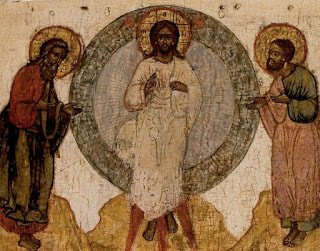
Transfiguration greetings from inside the cloud. I say this not simply because of the fog that envelopes us here in Cambridge as rain melts our record snowfall, not only because of the in-between place this diocese has entered in the wake of our bishop’s retirement announcement, or even in honor of the strange possibility that, as this article explains, "a new Archbishop of Canterbury and a new Pope may be enthroned in the same month." I say this inspired by Luke’s unique observation that all of those present on the transfiguration mount were not only “overshadowed” by a cloud but actually, terrifyingly, “entered into it” (Lk 9:34). In some way, Luke seems to do more with the Transfiguration, to link the very paschal mystery to it, and to make that mystery accessible to his readers—to all of us. In the hands of Luke, all of us are delivered into the mysterious liberation that is transfiguration.

This cloud-envelopment is not the only unique gift brought to us by the Year C in our liturgical/lectionary rotation. Only Luke, among the synoptic witnesses, gives us a window onto the summit conversation between Jesus, Moses and Elijah. All three accounts tell us that Peter, John and James see these towering figures of the Law and the Prophets. But Luke alone explains that “they appeared in glory” and, most importantly, that “they were speaking of [Jesus’] departure which he was about to accomplish at Jerusalem.”  The term for departure is ἔξοδον, a word that evokes the Exodus of the Israelites from their Egyptian captivity. Already the gospel story draws upon Moses’ shining encounter, as our first reading reminds us. But Luke’s window onto Jesus’ mountaintop discourse gives us more on which to chew. Jesus was about to embody Exodus. Think about what that might mean. Think of what we know about the journey that lay before him: the downward slope into Jerusalem, the crucifixion, the resurrection and ascension. The shorthand Luke uses for this, the frame through which he wants us to read it, is ἔξοδον. It is liberation from oppression. It is the transformation of an individual body—suffering and death followed by resurrection life—as the transformation of a collective body. Does this relationship of collective to individual embodiment not shift how you might read Jesus’ words of agency? Do you not hear the notion of “accomplishing” this paschal mystery in a different way? It is not simply a matter of deciding to suffer and to die (which, of course, is not simple in and of itself). This “accomplishment” is about the exodus of a people, or as Paul puts it in our reading from 2 Corinthians, freedom, which flows out from “the Spirit of the Lord” (2 Cor 3:18).

Both in written reflection and in iconic depiction, the Christian East has long honored the Metamorphosis (as it is often called, after the term with which Matthew and Mark describe Jesus’ transformation), and has seen in it a deep connection to the mystery of Easter itself. Transfiguration is not only something that happened to Jesus on Mount Tabor, as our unnamed peak is often called. It is also the effect of resurrection power in our lives here and now, as well as at the end of all things, when that power will lift us up from the grave.  Transfiguration is the transformation “from glory into glory” to which Paul speaks in this breathtaking vision: “all of us, with unveiled faces, seeing the glory of the Lord as though reflected in a mirror, are being transformed into the same image from one degree of glory to another” (2 Cor 3:18). This is not an effect reserved for the end. It is with us now. It is why, “we do not lose heart” as we carry forward in our ministries (2 Cor 4:1). The present, pervasive reality of transfiguration allows us to discern the holy in this cloud in which we stand.

The idea that to be transfigured is to be changed, to be transformed, to be metamorphosed first drew me to the theology of transfiguration-- as someone who has transitioned, this spoke powerfully to me. The complexity of my gender identity also gave me a particular appreciation for its liminal placement in the liturgical year. But surely I am not alone in my love of the uniquely clear way in which the Transfiguration (and more specifically Transfiguration Sunday, placed here, at the threshold of Epiphany and Lent) makes the heart of the gospel-- the good news of God’s transforming, healing, reconciling work -- available to us, a prism through which to see our own lives as in some way part of this larger collection, these stories of salvation history. This combination of liminality and transformation should prompt us to see not only the obviously-set-apart places, the mountaintop locales, but also the more mundane interstices, the in-between spaces of our lives, as places of transfiguration. 

These thresholds can be temporal, spatial or both. Perhaps we might look afresh at the context of divinity school and of the university more broadly. This context is a crucible—as you surely don’t need me to tell you—a space of intensive formation, and which carries to some degree the anxiety of next-steps, both for students and for faculty and staff. And so I want to invite us all to consider here and now, in this peculiar perch: What is the ἔξοδον you are about to accomplish, or rather, that God is about to accomplish in you?  How are you being called to embody the paschal mystery in all its incorporation of death and new life?  Stand on this verge today and know that by virtue of your membership in the body of Christ, you too are being transfigured. You, dear friends, are caught up in the mystery of metamorphosis. You are poised to leap up from the sacramental waters of your baptism. In the least likely spaces of your life, you are being “changed from glory into glory,” invited to grow like the engrafted olive shoot you are into the very heart of the living God. The death Christ died and the resurrection life through which creation itself was recast—these fundamental tenets of our faith our not mental exercises, but spiritual realities with deeply concrete implications. As we move toward the dust-filled return of Ash Wednesday and the wilderness territory of Lent, think on this mystery.

Luke’s vision of the Transfiguration frames our entry into Lent and Easter like no other gospel. To be sure, the placement of this day at the end of the season of Epiphany, as the bookend to Jesus’ baptism (another iconic favorite in Eastern Christianity) works similarly in all three years of our lectionary. Transfiguration stands as the mandorla, the holy hinge on which the cycles of Incarnation and Pascha swing into one another. But Luke’s version alone gives us a prism through which to read the Paschal Mystery itself. Luke alone truly uses Transfiguration as the key for interpreting the cross and the empty tomb. Luke alone refracts our very body/ies through the lens of Exodus (for an Easter preview, see Luke 24:1-12).  And so again I ask you, what is the ἔξοδον that God is seeking to accomplish in you? How are you being called to embody the liberation that is the Paschal Mystery?

- The Rev'd Dr. Cameron Partridge 

1 Comment

A Service-- and Sermon-- of Renaming

5/19/2010

0 Comments

 
The week before last at my congregation, we celebrated in the context of the Sunday Eucharist the legal name change of a community member, Anderson Michael C. I put together a liturgy drawing from several sources, including Justin Tannis's book Trans-gendered: Theology, Ministry, Community, the Standing Commission on Liturgy Music's book called Changes: Prayers and Services Honoring Rites of Passage, and a prayer written by another parishioner who is working on a liturgy for people in transition.  

In addition, Anderson preached the sermon and gave me permission to share it on this blog. Anderson also created the graphic (pasted below where it was in his original text) which he put on invitations to friends and community members, and which I also used on the cover of the worship booklet.

CP

Sermon – Anderson C's Rite of Naming – 9 May 2010

I am very happy to see you all here today. It means a lot to be able to share this special day with you and celebrate the claiming of my name, so I thank you for coming. I also thank Cameron and you for giving me this opportunity to preach the sermon today.

I think we are fortunate to have this particular Gospel reading today from John: Jesus said, “Peace I leave with you; my peace I give to you… Do not let your hearts be troubled or afraid.”

With those words, the resurrected Jesus comforted the apostles just before he left them, and before they left each other to go out into the world and spread God’s word. I hope that we, too, can find comfort in those words for ourselves with whatever difficulties life presents as we go out and live in the world in our daily lives.

For me, one of the things I take with me when I go out from here will be my name, which I claim today. For you, the members of this congregation and also my friends who are here today for this Rite of Naming, I would like to offer to you my story because you all have played a part in it. And in this story is a lesson that I would like to share with you so that you can take it with you.

Last year at about this time, I was in this church for the Stations of the Cross on Good Friday, and something happened to me that had never happened before in my life. As I listened to the words, the description of what Jesus endured that day had an impact that I had never felt before. Prior to last year, the readings were just a story, like in a novel or a screenplay. Intellectually, I understood the series of events and their significance, but emotionally, I never felt them, until last year. It was then that I could see the events in the context of Jesus as a real person rather than, as I had in the past, just a character in a story. I could feel His vulnerability and suffering even though I had not been able to before.  

Similarly, just as I had felt the pain of Jesus’ crucifixion, I also experienced the glory of His resurrection days later. The questioning when the tomb was found empty, the surprise when He appeared in a locked room with the apostles, the skepticism of Thomas, the relief, happiness and wonder when they realized He had triumphed over death.

You might wonder why I hadn’t experienced this emotional connection to the humanity of Jesus until just last year at the age of 48, or why I was even detached from it in the first place. The answer is that this was a consequence of my being transgender.

For some people who grow up as transgender, they learn how to present a persona that the rest of the world wants to see. There are so many signals to children about how they should be as people, and for some transgender children, the signals can be that the person they really are is “bad.” For example, in kindergarten, I was once yanked by the sleeve from the line of boys waiting to use the bathroom (which is where I thought I should have been because, after all, I was a boy) and I was towed over to the line of girls. The teacher’s aide who did the yanking said to another, “She did it again! Why can’t her parents teach her which bathroom to use?” So with that little remark, I received the message that if I did what I felt inside, not only was I wrong, but my mom and dad were bad parents. That is a really difficult and confusing message for a five-year old to grapple with.

So what happens in some of these cases is that some transgender children, to the best of their ability, construct a persona that matches the name and sex on their birth certificate and that meets the expectations of everyone around them, especially the people they love and want to please most -- their parents and siblings, their teachers, their friends. In doing so, their true self can become buried inside, their emotions silenced for the sake of survival, and they sometimes are unable to feel.  

I was unable to feel. The analytical left side of my brain put the smack-down on the emotional right side when I was a child and held onto control for dear life. I went through the decades as a detached observer of my own life rather than as a true participant. Loneliness came from the inability to feel not only what was going on inside of myself, but also the emotional connections that people in my life tried to make with me. Intellectually, I could see how I affected others and how they valued me, but I couldn’t feel it. And the worst part of all of it was that I didn’t know that I couldn’t feel it. I thought that seeingit was feeling it. So I took the role of the observer, and somehow made connections with people by mentally translating their actions into crude emotional representations.

That held true for God’s love as well. I would sometimes lay awake at night as a child and remember what I had been taught about God’s love, and I would close my eyes and try to feel it, because I knew that if I could, it would feel wonderful. When I was unable to connect with it, I comforted myself as best I could by knowing that Jesus said that he loves us and so it must be true.  

Eventually when I got older, I left the church. That’s not a big surprise considering I could not emotionally tie into God’s grace or even really connect with the other members of the congregation. I didn’t lose my faith though. I thought about it, reasoned it, analyzed it, but couldn’t act on it. Eventually, after years of being away, I returned because of an ache for the spirituality and communion of religion.  

I attended a church that was down the street from my house. I was content for a while and derived comfort from attending services and the occasional church event. Then one day during mass, a woman sitting near me refused to share with me the sign of peace. I watched her extend her hand to everyone around her but then she looked me in the eye as I extended my hand toward her and she refused to take my hand in hers. Now all my life many people have assumed, based on the way I presented myself, that I was a butch lesbian, and this woman might have had the same judgment of me. Certainly, the way she acted was not in keeping with Jesus’ own peace that he left with his apostles and with us, as we heard today. I left that church that day and didn’t go back.

It was around that time that I experienced a small event that led to a momentous epiphany. The small event was a cab ride in San Francisco – the cab driver called me “Sir.” I analyzed that small event for several weeks until, in a defining moment of clarity that came while I was washing the dishes at my kitchen sink, all of the puzzle pieces of my life that had been suspended in a disorganized floating jumble suddenly aligned and snapped together, forming a picture of my true self. My mind could no longer support the persona that I had built for myself over the decades, could no longer pretend to be the woman that I and everyone around me thought I was. I suddenly realized who I was not, and I also thought that I was the “wrong” kind of person. I had worked for 45 years to smother the true person I was, so accepting and loving myself was a concept that was foreign to me.

And so the real work began, peeling back the layers upon layers of persona to reveal the real me, a painstaking process in which I was engaged when I came to this church for the first time. I came after attending Transgender Day of Remembrance here in November of 2008. I had no church to call my own, this one looked really nice and I knew the vicar. With an ache to once again belong to a spiritual home, I contacted Cameron and asked him what time that services were held on Sundays.  

As I continued to attend this church, with Cameron’s help, I had the courage to be here as my true self, and it was the very first time in my life I lived simply as me. I cannot even tell you how validating and affirming that was. But a funny thing was happening at the same time. Apparently, I began to matter. I didn’t realize it, but Cameron would tell me that I did. He would take me aside and try to point out the impact that I was having in this congregation, but I didn’t get it. I couldn’t feel it, and so I would brush aside what he was telling me. And then we would look at each other, both of us perplexed, he, I think, because he couldn’t understand why I couldn’t see what, to him, was so apparent, and me because I couldn’t understand how he could be so sure about something that I couldn’t feel myself.

At the same time, my therapist was working on a similar project, trying to help me realize that I mattered, that people cared about me and that I was deserving of their love. I didn’t feel that either. It bounced off of me because I was unable to let it in. How could I accept love from others when I couldn’t even love myself? But my therapist kept trying, coming at it from different angles and using different methods, trying to help me accept and care about myself and see my own value in the world.

There were also close friends in whom I had confided and told about my “situation,” members of a support network I had formed in order to stay afloat as I navigated the sometimes treacherous waters of this process of finding myself. Some of those people are sitting in this room today. And those people, by accepting me after I told them the truth about who I was, also, in their own way, gave me the freedom to be myself. Their acceptance, your acceptance, helped me to accept myself.

So there was a continuous stream of caring from all sides. From members of this congregation, from my therapist, from my friends, who all worked, knowingly or unknowingly, to eventually erode the shell in which I had been abiding. Without the shell, my emotions were exposed, raw and sensitive, but I could feel. In addition, I became able to accept myself and to love myself and thereby also allow the love from those around me to penetrate, to come inside and allow me to stand free in the warmth of love.  

God has been patiently waiting for me while I have journeyed to this point. And today, like Simon Peter when he heard the Lord call, I swim to meet Him and I clothe myself in my new name, to present myself to Him, and to you, as my true self. I would not have been able to do so without all of you.

And now you know my story, how I came to this church in the fall of 2008, how one year ago, I came to more fully understand Jesus’ humanity, and how I have reached the point of claiming my name. With this story, as I mentioned at the beginning of this sermon, there is a lesson for all of us, including me, which is:
When you help someone to love them self, you give them the ability to feel the love of others and the love of God and to allow that love to enter into their heart.  

This is what everyone in this room has done for me. You gave me your peace, my heart is no longer troubled or afraid, and I feel loved. In this way, I can claim my true name of Anderson Michael C. For this gift, I thank all of you.
Picture
0 Comments

    Archives

    August 2025
    June 2025
    May 2025
    April 2025
    March 2025
    January 2025
    November 2024
    August 2024
    July 2024
    June 2024
    May 2024
    April 2024
    October 2023
    September 2023
    July 2023
    May 2023
    March 2023
    November 2022
    August 2022
    July 2022
    May 2022
    March 2022
    February 2022
    November 2021
    August 2021
    May 2021
    March 2021
    February 2021
    August 2020
    June 2020
    November 2019
    March 2019
    December 2018
    October 2018
    July 2018
    February 2018
    November 2017
    August 2017
    April 2017
    July 2015
    June 2015
    March 2015
    February 2015
    September 2014
    March 2014
    February 2014
    February 2013
    November 2012
    September 2012
    July 2012
    June 2012
    May 2012
    March 2012
    January 2012
    November 2011
    May 2011
    April 2011
    March 2011
    February 2011
    December 2010
    November 2010
    October 2010
    May 2010
    April 2010
    February 2010
    January 2010
    December 2009
    November 2009
    September 2009
    August 2009
    July 2009
    June 2009
    April 2009
    January 2009
    November 2008
    October 2008
    August 2008
    July 2008
    June 2008
    April 2008
    March 2008
    February 2008
    January 2008
    December 2007
    November 2007
    October 2007
    September 2007
    August 2007
    July 2007
    June 2007
    May 2007
    April 2007
    March 2007

    Categories

    All
    77th General Convention
    80th General Convention
    81st General Convention
    A063
    A063 2022
    A064 2018
    A068 2018
    A088 2018
    A091 2018
    A143 2018
    A284 2018
    Aaron Scott
    Advent
    Advocacy
    Allies
    All Saints
    Allston/Brighton
    Anglican Communion
    Anglican Communion Listening Process
    Anglican Comprehensiveness
    Anglican Primates Dar Es Salaam Communiqué
    Annie Lawson
    Anti Trans Legislation
    Anti Trans Violence
    Anti-trans Violence
    Archbishop Of Canterbury Rowan Williams
    Art
    Ascension
    Asceticism
    Author Anderson C.
    Author: Bear
    Author: Cameron Partridge
    Author: Carla Robinson
    Author: Charley Labonte
    Author: Christina Beardsley
    Author: Dante Tavolaro
    Author: Donna Cartwright
    Author: Gari Green
    Author: Gwen Fry
    Author: Iain Stanford
    Author: Jim Toy
    Author: Kit Wang
    Author: Kori Pacyniak
    Author: Liz
    Author: Louise Brooks
    Author: Meredith Bacon
    Author: Mia Nikasimo
    Author: Michelle Hansen
    Author: Penny Larson
    Author: Sarah Lawton
    Author: Shane Keefer
    Author: Shelly Fayette
    Author: Teal Van Dyck
    Author: Vicki Gray
    Author: Weston Morris
    B012 2018
    B033
    Baptism
    Baptismal Covenant
    Becoming
    Believe Out Loud
    Bishop Barbara Harris
    Bishop Bill Swing
    Bishop Bud Cederholm
    Bishop C. Andrew Doyle
    Bishop Catherine Roskam
    Bishop Catherine Waynick
    Bishop Chet Talton
    Bishop Dabney Smith
    Bishop Dorsey Henderson
    Bishop Duncan Gray
    Bishop Election Consent Process
    Bishop Gene Robinson
    Bishop Geralyn Wolf
    Bishop Ian Douglas
    Bishop J. Clark Grew
    Bishop John Chane
    Bishop Jon Bruno
    Bishop Larry Benfield
    Bishop Marc Andrus
    Bishop Mark Beckwith
    Bishop Mark Lawrence
    Bishop Mary Glasspool
    Bishop Otis Charles
    Bishop Prince Singh
    Bishop Samuel Howard
    Bishop Steven Charleston
    Bishop Tom Shaw
    Bishop William Love
    Blackburn Motion
    Blessing
    Book Of Occasional Services
    Boston
    Brandon Teena
    Buddhism
    Bullying
    C001 2009
    C001-2009
    C006 2018
    C010 2024
    C019 2015
    C022 2018
    C029 2018
    C030 2006
    C031 2018
    C046 2009
    C046-2009
    C048 2009
    C048-2009
    C054 2018
    C056 2009
    C061 2009
    C061-2009
    Cameron Partridge
    Camp Aranu'tiq
    Campus Ministry
    Canon Edward Rodman
    Cathedral Church Of St. Paul
    Catholic
    Chanelle Pickett
    Changing Attitude
    Changing Attitude Nigeria
    Chaz Bono
    Chris Ashley
    Christian Formation
    Christmas
    Church Of England
    Church Of The Advocate
    Collaboration
    Colonialism
    Coming Out
    Communion Of Saints
    Compassion
    Complementarianism
    Connecticut
    Courage
    D002
    D002 2012
    D005 2018
    D012 2009
    D012-2009
    D019
    D019 2012
    D022
    D022 2012
    D025
    D029 2022
    D030 2022
    D032 2009
    D036
    D036 2015
    D036 2018
    D037 2015
    D039 2009
    D066 2022
    D069 2018
    D072 2022
    D090 2009
    Dallas Transgender Advocates And Allies
    Damien De Veuster
    Dante Tavolaro
    David & Goliath
    Davis Mac-Iyalla
    Debra Forte
    Deployment
    Dialogue
    Diatesseron
    Diocesan Convention
    Diocese Of Arkansas
    Diocese Of California
    Diocese Of Connecticut
    Diocese Of Florida
    Diocese Of Los Angeles
    Diocese Of Louisiana
    Diocese Of Massachusetts
    Diocese Of New York
    Diocese Of Olympia
    Diocese Of San Joaquin
    Diocese Of South Dakota
    Diocese Of Texas
    Discernment
    Discrimination
    Divinity School
    Donna Cartwright
    Drew Phoenix
    Easter
    Easter Embodiment
    Easter Vigil
    ELCA
    ELCA New England Synod
    Elizabeth Clark
    Empathy
    ENDA
    Episcopal Church
    Episcopal Divinity School
    Eunuchs
    Evangelical Christianity
    Executive Council
    Exodus
    Families Of Trans People
    Family
    Family Diversity Project
    Florida
    Forms
    Fringe Festivals
    Gay
    #GC80
    Gender
    Gender Affirming Care
    Gendered Language
    Gender Identity
    Gender Justice Staff Officer
    Gender Neutral Restrooms
    Genderqueer
    General Convention
    General Convention 2006
    General Convention 2009
    General Convention 2012
    General Convention 2015
    General Convention 2018
    General Synod
    #givingtuesday
    GLAD
    Gospel Of John
    Gospel Of Luke
    Grace Cathedral
    Grief
    Gwen Araujo
    Gwen Smith
    Harvard Divinity School
    Harvard University
    Harvey Milk
    Hate Crimes
    Haunting
    Hawaii HB 546
    Healing
    Hinge Days
    HIV/AIDS
    Holy Spirit
    Homophobia
    Homosexuality
    Hope
    House Of Bishops
    House Of Deputies
    HR 1913
    HRC
    Iain Stanford
    I AM
    Incarceration
    Incarnation
    Indaba Groups
    Institute For Welcoming Resources
    Integrity Eucharist
    IntegrityUSA
    Interfaith Coalition For Transgender Equality
    Intersectionality
    Iowa Equal Marriage
    Isaiah 56
    Jendi Reiter
    Jennifer Finney Boylan
    Jim Toy
    John 21:1-19
    Joy
    J.R.R. Tolkien
    Judith Butler
    July 4th
    Jump Rope
    Kintsukuroi
    Kit Wang
    Kylar Broadus
    Labor Organizing
    Lambeth Conference
    Lay Ministry
    Lent
    Leprosy
    LGBTIQ
    LGBTQ Africans
    LGBTQ Anglicans
    LGBTQIA+
    LGBTQ Pride
    Liberation
    Liminality
    Louie Crew
    Louise Brooks
    Lutherans Concerned North America
    Maine
    Mark Jordan
    Marriage Equality
    Maryland HB 235
    Mary Miller
    Masks
    Massachusetts
    Massachusetts HB 1722
    Massachusetts HB 1728/SB 1687
    Massachusetts Transgender Political Coalition
    Matthew 25
    Media
    Michelle Kosilek
    Myra Chanel Ical
    Name Change In Church Records
    Name Change Liturgy
    Names
    Narrativity
    National Transgender Discrimination Survey
    New England
    News Coverage
    Nigeria
    Nonbinary
    Nondiscrimination Canons
    Oasis California
    Oregon
    Organization
    Other Sheep
    Pain
    Palm Sunday
    Parachute
    Parenting
    Parents Of Trans People
    Passion Narratives
    Pentecost
    Philadelphia
    Prayer Book
    Prayer Book Revision
    Presidential Election
    President Of The House Of Deputies
    President Of The House Of Deputies Bonnie Anderson
    Presiding Bishop Katharine Jefferts Schori
    Presiding Bishop Michael Curry
    Press Release
    Priesthood
    Prison Ministries
    Proclamation
    Public Accomodations
    Queer Youth
    Race
    Racial Justice
    Racism
    Reconciling Ministries Network
    Reign Of God
    Religion
    Religious Life
    Remain Episcopal
    Renaming Service
    Repair
    Resilience
    Resistance
    Restrooms
    Resurrection
    Retreat
    Rhiannon O'Donnabhain
    Richard Hooker
    Rita Hester
    Roman Catholic Church
    Ronald Miller
    Ruby Rodriguez
    Salem
    Same Sex Blessings
    San Francisco Night Ministry
    Sarah Lawton
    Sedementation
    Sermon
    Sexism
    Sexuality
    Sexuality Debates
    Sexual Minorities Uganda
    Sexual Orientation
    Sex Work
    Side-wound
    Sonia Burgess
    Spirituality
    St. Anne's
    Stephanie Spellers
    Stigma
    St. Luke's And St. Margaret's Allston
    St. Martin In The Fields
    Stockton
    St. Paul's
    Stumbling
    Suicidality
    Suicide
    Supreme Court Ruling
    TDOR
    TDOV
    Testimony
    Texas
    Texas HB 25
    The Briggs Initiative
    The Consultation
    The Cross
    The Crossing
    The Episcopal Church
    The Good Shepherd
    The Honorable Byron Rushing
    The Laramie Project
    Theological Anthropology
    The Philadelphia Eleven
    The Rev'd David Weekley
    The Rev'd Deacon Carolyn Woodall
    The Rev'd Deacon Vicki Gray
    The Rev'd Dr. Christina Beardsley
    The Rev'd Drew Phoenix
    The Rev'd Gari Green
    The Rev'd Gay Clark Jennings
    The Rev'd Gwen Fry
    The Rev'd Junia Joplin
    The Rev'd Michael Barlowe
    The Rev'd Paul Washington
    The Rev'd Susan Russell
    The Sibyls
    The Task Force
    Trans
    Transafro
    Trans Awareness Week
    Trans Civil Rights
    Trans Clergy
    Trans Day Of Visibility
    TransEpiscopal Eucharist
    Transfiguration
    Transformation
    Transgender
    Transgender Athletes
    Transgender Clergy
    Transgender Day Of Visibility
    Transgender Faith Leaders
    Transgender Moment
    Transgender Non Discrimination
    Transgender Non-discrimination
    Transgender Youth
    Trans Health
    Trans Inclusion
    Transition
    Trans Justice
    Trans Lesbian
    TransLutherans
    Trans Medical Care
    Trans Misogyny
    Transmisogyny
    Trans Narratives
    Trans Ordination
    Trans Ordinations
    Trans People Of Faith
    Transphobia
    Trans Preaching
    Trans Pride
    Trans Representation In Media
    Trans Sermons
    Transsexual
    Trans Spirituality
    Trans Studies
    Trans Women
    Trans Youth
    Trauma
    Travel
    Trinity Episcopal Cathedral Sacramento
    Trump Gender Memo
    UCC
    Uganda
    UMC General Conference
    United Kingdom
    United Methodist
    U.S. V. Skrmetti
    UUA
    Vendela Vida
    Vermont Equal Marriage
    Vice President Of The House Of Deputies
    Viktor Juliet Mukasa
    Violence
    Vocation
    Voices Of Witness Africa
    Voices Of Witness Out Of The Box
    Welcome One Another Fellowship
    Wholeness
    Wilderness
    Women Bishops
    Women's Ministries
    Women's Ordination
    World Mission Committee

    RSS Feed

Proudly powered by Weebly